
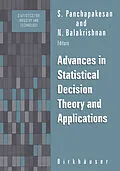
Advances in Statistical Decision Theory and Applications
Beschreibung
Shanti S. Gupta has made pioneering contributions to ranking and selection theory; in particular, to subset selection theory. His list of publications and the numerous citations his publications have received over the last forty years will amply testify to th...Format auswählen
- E-Book (pdf)CHF 59.90
- Kartonierter EinbandCHF 67.20
Wird oft zusammen gekauft
Andere Kunden kauften auch
Beschreibung
Shanti S. Gupta has made pioneering contributions to ranking and selection theory; in particular, to subset selection theory. His list of publications and the numerous citations his publications have received over the last forty years will amply testify to this fact. Besides ranking and selection, his interests include order statistics and reliability theory. The first editor's association with Shanti Gupta goes back to 1965 when he came to Purdue to do his Ph.D. He has the good fortune of being a student, a colleague and a long-standing collaborator of Shanti Gupta. The second editor's association with Shanti Gupta began in 1978 when he started his research in the area of order statistics. During the past twenty years, he has collaborated with Shanti Gupta on several publications. We both feel that our lives have been enriched by our association with him. He has indeed been a friend, philosopher and guide to us.
Inhalt
I: Bayesian Inference.- 1 Bayes for Beginners? Some Pedagogical Questions.- 1.1 Introduction.- 1.2 Unfinished Business: The Position of Bayesian Methods.- 1.3 The Standard Choice.- 1.4 Is Bayesian Reasoning Accessible?.- 1.5 Probability and Its Discontents.- 1.6 Barriers to Bayesian Understanding.- 1.7 Are Bayesian Conclusions Clear?.- 1.8 What Spirit for Elementary Statistics Instruction?.- References.- 2 Normal Means Revisited.- 2.1 Introduction.- 2.2 Selection Criteria.- 2.3 Model and Computations.- 2.4 Numerical Example.- References.- 3 Bayes m-Truncated Sampling Allocations for Selecting the Best Bernoulli Population.- 3.1 Introduction.- 3.2 General Outline of Bayes Sequential Sampling Allocations.- 3.3 Allocations for Bernoulli Populations.- 3.4 Numerical Results and Comparisons.- References.- 4 On Hierarchical Bayesian Estimation and Selection for Multivariate Hypergeometric Distributions.- 4.1 Introduction.- 4.2 Formulation of the Problems.- 4.2.1 Bayesian estimation of si, i=1,..., n.- 4.2.2 Bayesian selection rule.- 4.3 A Hierarchical Bayesian Approach.- 4.4 Optimality of the Hierarchical Bayesian Procedures.- 4.4.1 Optimality of ?H.- 4.4.2 Optimality of ?H.- References.- 5 Convergence Rates of Empirical Bayes Estimation and Selection for Exponential Populations With Location Parameters.- 5.1 Introduction.- 5.2 Bayes Estimators and Bayes Selection Rule.- 5.3 Empirical Bayes Estimators and Empirical Bayes Selection Rule.- 5.4 Asymptotic Optimality of the Empirical Bayes Estimators.- 5.5 Asymptotic Optimality of the Empirical Bayes Selection Rule.- 5.6 An Example.- References.- 6 Empirical Bayes Rules for Selecting the Best Uniform Populations.- 6.1 Introduction.- 6.2 Empirical Bayes Framework of the Selection Problem.- 6.3 Estimation of the Prior Distribution.- 6.3.1 Construction of the prior estimator.- 6.3.2 Consistency of the estimator.- 6.4 The Proposed Empirical Bayes Selection Procedure.- 6.5 Rates of Convergence.- References.- II: Decision Theory.- 7 Adaptive Multiple Decision Procedures for Exponential Families.- 7.1 Introduction.- 7.2 Adaptation for Exponential Families.- 7.3 Gamma Distributions Family.- 7.4 Normal Family.- References.- 8 Non-Informative Priors Via Sieves and Packing Numbers.- 8.1 Introduction.- 8.2 Preliminaries.- 8.3 Jeffreys' Prior.- 8.4 An Infinite Dimensional Example.- References.- III: Point And Interval Estimation-Classical Approach.- 9 From Neyman's Frequentism to the Frequency Validity in the Conditional Inference.- 9.1 Introduction.- 9.2 Frequency Validity under Model 1.- 9.3 Generalizations.- 9.3.1 Other statistical procedures.- 9.3.2 Frequency validity under Model 2 involving different experiments.- 9.4 Conclusions.- References.- 10 Asymptotic Theory for the Simex Estimator in Measurement Error Models.- 10.1 Introduction.- 10.2 The SIMEX Method.- 10.2.1 Simulation step.- 10.2.2 Extrapolation step.- 10.2.3 Sketch of asymptotics when B = ?.- 10.3 General Result and Logistic Regression.- 10.3.1 The general result.- 10.3.2 Logistic regression.- 10.4 SIMEX Estimation in Simple Linear Regression.- References.- 11 A Change Point Problem for Some Conditional Functionals.- 11.1 Introduction.- 11.2 Regularity Conditions and the Main Result.- 11.3 Some Discussions.- References.- 12 On Bias Reduction Methods in Nonparametric Regression Estimation.- 12.1 Introduction.- 12.2 The Bias Reduction Methods.- 12.3 A Monte Carlo Study.- References.- 13 Multiple Comparisons With the Mean.- 13.1 Different Types of Multiple Comparisons.- 13.2 Balanced MCM.- 13.3 Unbalanced MCM.- 13.3.1 Comparisons with the weighted mean.- 13.3.2 Comparisons with the unweighted mean.- 13.4 Recommendations.- References.- IV: Tests Of Hypotheses.- 14 Properties of Unified Bayesian-Frequentist Tests.- 14.1 Introduction.- 14.2 The New Bayesian-Frequentist Test.- 14.3 Normal Testing.- 14.4 The "Two-Sided" Normal Test With Shifted Conjugate Prior.- 14.5 The "Two-Sided" Test With Uniform Prior.- 14.6 Lower Bound on ?*.- 14.7 The "One-Sided" Test.- References.- 15 Likelihood Ratio Tests and Intersection-Union Tests.- 15.1 Introduction and Notation.- 15.2 Relationships Between LRTs and IUTs.- 15.3 Testing H0 : min{|,|} = 0.- 15.3.1 Comparison of LRT and IUT.- 15.3.2 More powerful test.- 15.4 Conclusion.- References.- 16 The Large Deviation Principle for Common Statistical Tests Against a Contaminated Normal.- 16.1 Introduction.- 16.2 LDP for Common Statistical Tests.- 16.3 Bahadur Slopes and Efficiencies.- References.- 17 Multiple Decision Procedures for Testing Homogeneity of Normal Means With Unequal Unknown Variances.- 17.1 Introduction.- 17.2 Some Preliminary Results.- 17.3 Decision Rule R.- 17.3.1 Pr{Type I error}.- 17.3.2 Pr{CD|R} and its infimum over??.- 17.4 Example.- References.- V: Ranking and Selection.- 18 A Sequential Multinomial Selection Procedure With Elimination.- 18.1 Introduction.- 18.1.1 Single-stage procedure.- 18.1.2 Sequential procedure.- 18.2 Cell Elimination Procedure for t = 3.- 18.2.1 Description of procedure.- 18.2.2 Operating characteristics.- 18.3 Comparison of MBK and MGHK.- 18.3.1 Simulation results.- 18.3.2 Discussion.- 18.4 Summary.- References.- 19 An Integrated Formulation for Selecting the Best From Several Normal Populations in Terms of the Absolute Values of Their Means: Common Known Variance Case.- 19.1 Introduction.- 19.2 Formulation of the Problem and Definition of Procedure R.- 19.3 Some Preliminary Results.- 19.4 P(CD1|PZ) and P(CD2|IZ) and Their Infima.- 19.5 Determination of n, c and d.- 19.6 Some Properties of Procedure R.- References.- 20 Applications of Two Majorization Inequalities to Ranking and Selection Problems.- 20.1 Introduction and Summary.- 20.2 Majorization and Two Useful Probability Inequalities.- 20.2.1 A review of majorization.- 20.2.2 A Schur-Concavity property of the joint distribution function.- 20.2.3 A Schur-Convexity property for exchangeable random variables.- 20.3 Probability Bounds Under the Indifference-Zone Formulation.- 20.3.1 The PCS function and the LFC.- 20.3.2 A lower bound for the PCS function under LFC.- 20.3.3 An upper bound for the true PCS function for location parameter families.- 20.3.4 The normal family.- 20.4 Bounds for PCS Functions Under the Subset Selection Formulation.- 20.4.1 Gupta's maximum-type selection rules.- 20.4.2 Location parameter families.- 20.4.3 Scale parameter families.- References.- VI: Distributions AND Applications.- 21 Correlation Analysis of Ordered Observations From a Block-Equicorrelated Multivariate Normal Distribution.- 21.1 Introduction.- 21.2 The Covariance Structure of Ordered Affine Observations.- 21.3 Correlation Parameters of ? When ? = ?.- 21.4 Inferences on ?.- 21.5 Large-Sample Distributions.- 21.5.1 Special cases.- 21.6 Intra-ocular Pressure Data.- 21.6.1 Inferences on ? under ? = ?.- 21.7 Conclusions.- 21.8 Derivations, 318 References.- 22 On Distributions With Periodic Failure Rate and Related Inference Problems.- 22.1 Introduction.- 22.2 Integrated Cauchy Functional Equation and Distributions Wit…
Produktinformationen
Weitere Bände aus der Buchreihe "Statistics for Industry and Technology"

- Advances in Statistical Decision Theory and Applications


