Beschreibung
Provides new insights on the novel approach called Hydrogeoethics in groundwater science and practice and the interlinkage with ethical philosophy, sustainable environment and societal concerns Enhances the understanding of groundwater and geoethics in model ...Provides new insights on the novel approach called Hydrogeoethics in groundwater science and practice and the interlinkage with ethical philosophy, sustainable environment and societal concerns Enhances the understanding of groundwater and geoethics in model regions in Europe, America, Africa, Asia and Middle-East Includes case studies that illustrate how hydrogeoethics understanding can contribute to promoting a more sustainable environment and better groundwater resources design with nature Discusses latest advances in groundwater management and geoethics from diverse backgrounds, as well as highlight the role of the climate change and anthropogenic pressures in groundwater systems Introduces Geoethics in Geosciences education at all levels, groundwater focused, aimed at professional and citizenship responsible actions in a changing world for sustainable development
Autorentext
Manuel Abrunhosa
Manuel Abrunhosa was born in Porto in 1954 and graduated in Geology from the University of Porto, Portugal, in 1980, and in 1988 a Master in Groundwater Hydrology from the Polytechnic University of Catalonia, Barcelona.
He began a full-time professional career as a Junior Geologist (Hydrogeology and Engineering Geology) in 1977, before graduation, pursuing studies and continuing his first job as a contracted helper to the practical classes of disciplines of his Geology course in the University of Porto, from 1974 up to 1980. In 1981, he became a partner and director in a small company of Applied Geology and Hydrogeology services. Since then, he directed and was author and co-author of innumerable projects aimed at the private and public sector until 2009. In 1981, after public exams, he became a Lecturer in Geology at the Faculty of Sciences of the University of Porto, having taught theoretical and practical classes in Hydrogeology, Engineering Geology, Sedimentary Petrology, Geomorphology, Geological Cartographic Methods, Mineralogy, Crystallography, Structural Geology and oriented pedagogic internships in secondary schools. He did research in hydrogeology of fractured media and participated in national and international research projects in this subject aiming water resources and groundwater management in the Minho region (NW Portugal) and in the optimisation of groundwater exploitation in complex well-field thin coastal sandy aquifer. Other active interest in science includes natural heritage studies and geoarchaeology with collaborations beginning since as a student with research groups in archaeology, ethnology and history. He was involved in 1990 in the foundation of the first academic course on Environmental Health and Hygiene that included curricula in geology and hydrogeology. He was also involved in a first master's in Environmental Marketing. He is often called as Forensic Geology expert witness and as pro bono scientific advisor to cultural and natural heritage and environmental advocacy associations.
Since 2006, he is an independent Consultant Geologist. He is a member of several national and international scientific and professional associations. At the Portuguese Association for the Study of the Quaternary - APEQ - (publisher of Estudos do Quaternário /Quaternary Studies), he is the Secretary of the Board and is President of the AIH-GP Portuguese Chapter of the International Association of Hydrogeologists (IAH). As an active member of the International Association for Promoting Geoethics (IAPG), he was invited in 2017 to his Board of Experts (Corresponding Citizen Scientists) in Geoethics in Groundwater Management. In 2018, he was jointly designated by IAH and IAPG as Chair of the international congress Geoethics & Groundwater Management: Theory and Practice for a Sustainable Development, in preparation, to be held at ISEP, Porto, Portugal, from 21 to 25 October 2019.
The ethics at the profession, in science production and in the applied Earth Sciences, has always been a concern and a guideline for his activities, a challenge for a geologist who, being born from a school oriented to the exploration and exploitation of geological resources in what he calls predatory geology, has gradually changed his priorities to become a Geoethics Advocate, an Environmental and Social Geologist for Sustainability.
António Chambel
A. Chambel is a skilled Geologist and Professor of Hydrogeology and Water Resources at the University of Évora, with over 35 years' experience in multidisciplinary groundwater research, consultancy and practice. He graduated in Geology from the University of Coimbra in 1984 and obtained an M.Sc. in Economic and Applied Geology from the University of Lisbon in 1990 and Ph.D. in Geology, specialising in Hydrogeology, from the University of Évora in 1999. His research interests are hydrogeological mapping, environmental hydrogeology, water resources management, groundwater modelling, urban groundwater, groundwater engineering, applied geology, among others.
He has been a teacher of hydrogeology in the Department of Geosciences of the University of Évora since 1985 and from 2003 to 2005 was President of the Department. He has also been an Invited Professor in the University of Algarve (Portugal), in the Universities Charles of Prague (Czech Republic), Huelva (Spain) and Sapienza Rome (Italy), under the ERASMUS Programme, and in the Institute of Transports and Communication (master's in Environmental Impact Studies) in Maputo, Mozambique.
From 2002 to 2006, he was President of the South Chapter of the Portuguese Water Resources Association (APRH), and from 2004 to 2008, he was the President of the Portuguese Chapter of the International Association of Hydrogeologists (AIH...
Klappentext
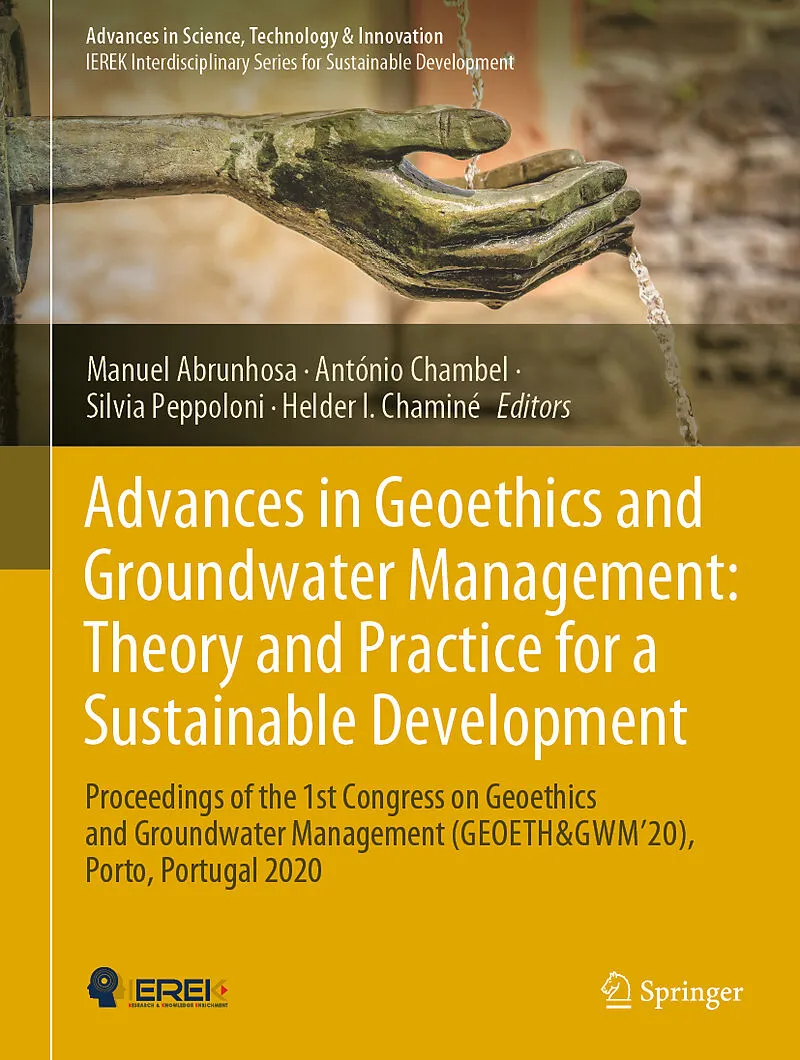
This book gathers the peer-reviewed proceedings of the 1st congress on Geoethics & Groundwater Management (GEOETH&GWM'20), held in Porto, Portugal, in an online format on 18-22 May 2020. Hosted in School of Engineering (ISEP), Polytechnic of Porto based on Porto city (a UNESCO World Heritage Site), the international conference focused on what has now been dubbed hydrogeoethics, a novel transdisciplinary, scientific field integrating all dimensions of geoethics in groundwater science and practice. Given its scope, the book is of interest to all researchers and practitioners in the geosciences, hydrology, water resources, hydrogeology, natural resources management, environment, engineering, law, sociology, education, philosophy, culture, among others.
This joint congress is the result of a collaborative agreement between the IAH (International Association of Hydrogeologists) and IAPG (International Association for Promoting Geoethics) and reflects the need for concerted actions to achieve sustainable development.
The diversity, scale, significance and increasing magnitude of anthropogenic interactions with aquifers and groundwater, which often involve conflicting values or interests, call for analysis, discussions and decisions on the part of the agents involved, e.g. groundwater scientists, policymakers, managers, organisations, professionals and citizens. This approach calls for a responsible, sustainable and human approach to groundwater use and management.
The groundwater community involved in the exploration and exploitation, use and management of this increasingly vital natural resource is becoming more and more aware that ethical issues pervade all our attitudes from concept to action and need to be addressed. Diverse values and cultures, science and education, law and policies, human and natural environments and the public and the economic sectors view groundwater and its value and/or role differently. The authors believe that in a globalised and interconnected world, common ground must be found in the interest of peace, human development and sustainability.
The main topics covered here include: