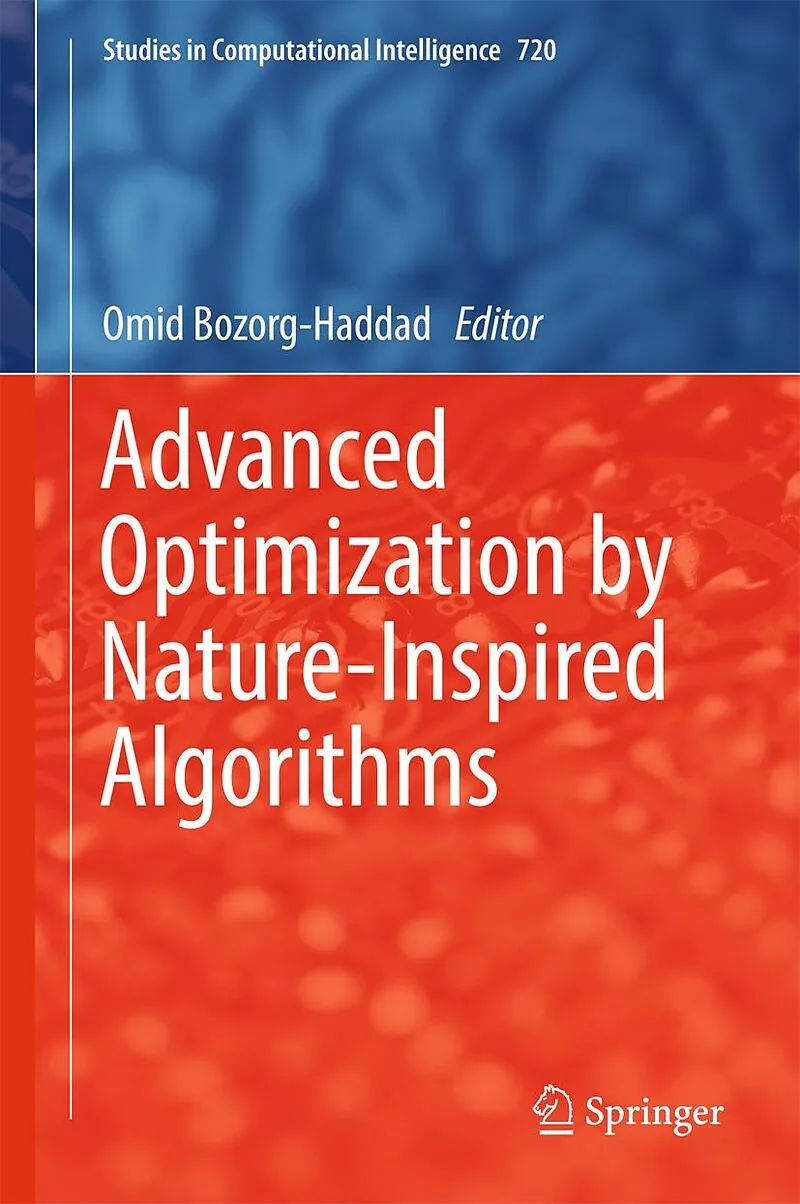
Advanced Optimization by Nature-Inspired Algorithms
Beschreibung
This book, compiles, presents, and explains the most important meta-heuristic and evolutionary optimization algorithms whose successful performance has been proven in different fields of engineering, and it includes application of these algorithms to importan...Format auswählen
- E-Book (pdf)CHF 106.90
- Fester EinbandCHF 155.20
- Kartonierter EinbandCHF 144.80

Wird oft zusammen gekauft
Andere Kunden kauften auch
Beschreibung
This book, compiles, presents, and explains the most important meta-heuristic and evolutionary optimization algorithms whose successful performance has been proven in different fields of engineering, and it includes application of these algorithms to important engineering optimization problems. In addition, this book guides readers to studies that have implemented these algorithms by providing a literature review on developments and applications of each algorithm. This book is intended for students, but can be used by researchers and professionals in the area of engineering optimization.
Autorentext
Dr. Omid Bozorg-Haddad is a Professor at the department of irrigation and reclamation engineering, University of Tehran, Iran. His teaching and research interests include water resources and environmental systems analysis, planning, and management as well as application of optimization algorithms in water related systems. He has published more than 100 articles in peer reviewed journals and 100 papers in conference proceedings. He has also supervised more than 50 M.Sc. and Ph.D. students.
Prof. Hugo Loaiciga served as the Water Commissioner for the City of Santa Barbara for six years before joining the Department in 1988. He received the 2002 Service to the Profession Award from the American Society of Civil Engineers and the Environmental and Water Resources Institute for his "longstanding contributions to research and technical activities" of the two groups, and he was elected a Fellow of the American Society of Civil Engineers for his "outstanding contributions to the planning, analysis, and operation of water resources engineering" in 2007.
Inhalt
Chapter 1: Overview of Optimization Summary This chapter briefly explains optimization and its basic concepts. Also, examples of the different types of engineering optimization problems are presented in this chapter. 1.1 Optimization 1.2 Examples of engineering optimization problems 1.3 Conclusion Chapter 2: Introduction to Meta-heuristic and Evolutionary Algorithms Summary This chapter begins with a brief review of different independent-problem methods for searching the decision space, describes the components of meta-heuristic and evolutionary algorithms by relating them to engineering optimization problems. Other related topics such as coding meta-heuristic and evolutionary algorithms, dealing with constraints, objective functions, solution strategies, are reviewed. A general algorithm is presented that encompasses most of the steps of all known meta-heuristic and evolutionary algorithms. This generic presentation provides a standard reference with which to compare all the known meta-heuristic and evolutionary algorithms. The chapter closes with the performance evaluation of the meta-heuristic and evolutionary algorithms covered by the book. 2.1 Searching decision space for optima 2.2 Definition of terms related meta-heuristic and evolutionary algorithms 2.3 Foundation of meta-heuristic and evolutionary algorithms 2.4 Classification of meta-heuristic and evolutionary algorithms 2.5 Coding meta-heuristic and evolutionary algorithms in both discrete and continuous domains 2.6 Generating random values 2.7 Dealing with constraints 2.8 Fitness functions 2.9 Selection of decision variables, parameters 2.10 Generating new solutions 2.11 The best solution 2.12 Termination criteria 2.13 General algorithm 2.14 Performance evaluation of meta-heuristic and evolutionary algorithms 2.15 Conclusion Chapter 3: Pattern Search (PS) Summary This chapter explains the pattern search (PS) algorithm, which is classified as a direct search method. The chapter starts with a brief literature review of the development of PS, important modification of the algorithm, and its applications to engineering domains. The basic idea underlying the algorithm is presented and mapped to its mathematical statement. Afterwards, the different steps of the algorithm are described in detail. A pseudo code of the algorithm is presented that serves as an easy and sufficient guideline for coding the algorithm. 3.1 Introduction 3.2 Pattern search (PS) foundation 3.3 Generating initial solution 3.4 Generate trial solutions 3.5 Update mesh size 3.6 Termination criteria 3.7 User-defined parameters of the PS 3.8 Pseudo code of the PS 3.9 Conclusion 3.10 References Chapter 4: The Genetic Algorithm (GA) Summary This chapter describes the genetic algorithm (GA), which is a well-known evolutionary algorithm. The chapter starts with a brief literature review of the GA's development, followed by presentation of the modification that it has experienced, and its applications in engineering domains. The basic idea underlying the algorithm is presented and mapped to its mathematical statement. Afterwards, the different steps of the algorithm are described in detail. A pseudo code of the algorithm is presented that serves as an easy and sufficient guideline for coding the algorithm. 4.1 Introduction 4.2 Mapping natural evolution into genetic algorithm (GA) 4.3 Creating the initial population 4.4 Selection of decision variables, parameters 4.4.1. Proportionate selection 4.4.2. Ranking selection 4.4.3. Tournament selection 4.5 Reproduction 4.6 Population diversity and selective pressure4.7 Termination criteria 4.8 User-defined parameters of the GA 4.9 Pseudo code of the GA 4.10 Conclusion 4.11 References Chapter 5: Simulated Annealing (SA) Summary This explains the simulated annealing (SA) algorithm, which is inspired by the process of annealing in metal work. The chapter starts with a brief literature review of the SA development, important modifications that it has experienced, and its applications in engineering domains. The basic idea underlying the algorithm is presented and mapped to its mathematical statement. Afterwards, the steps of the algorithm are described in detail. A pseudo code of the algorithm is presented to serve as an easy and sufficient guideline for its coding. 5.1 Introduction 5.2 Mapping physical annealing process into simulated annealing (SA) algorithm 5.3 Generating initial state 5.4 Generating a new state 5.5 Acceptance function 5.6 Temperature equilibrium 5.7 Temperature reduction 5.8 Termination criteria 5.9 User-defined parameters of the SA 5.10 Pseudo code of the SA 5.11 Conclusion 5.12 References Chapter 6: The Tabu Search Algorithm (TSA) Summary This chapter explains the Tabu search algorithm (TSA) which is combinatorial in nature. The chapter starts with a brief literature review of the TSA's development, important modifications that it has experienced, and its applications in engineering domains. The basic idea underlying the algorithm is presented and mapped to its mathematical statement. Afterwards, the steps of the algorithm are described in detail. A pseudo code of the algorithm is presented to serve as an easy and sufficient guideline for its coding.6.1 Introduction 6.2 Tabu search foundation 6.3 Generating initial searching point 6.4 Neighbor points 6.5 Tabu list 6.6 Updating Tabu list 6.7 Attributive Memory 6.8 Aspiration criteria 6.9 Intensification and diversification strategies 6.10 Termination criteria6.11 User-defined parameters of the TS 6.12 Pseudo code of the TS 6.13 Conclusion 6.14 References Chapter 7: Ant Colony Optimization (ACO) Summary This chapter explains ant colony optimization (ACO). The basic concepts of the ACO are derived from nature and are based on the forging behavior of ants. The chapter starts with a brief literature review of ACO's development, important modifications that it has experienced, and its applications in engineering domains. The basic idea underlying the algorithm is presented and mapped to its mathematical statement. Afterwards, the steps of the algorithm are described in detail. A pseudo code of the algorithm is presented to serve as an easy and sufficient guideline for its coding.7.1 Introduction 7.2 Mapping ants' behavior into ant colony opti…
Produktinformationen
Weitere Bände aus der Buchreihe "Engineering (R0)"

- Advanced Optimization by Nature-Inspired Algorithms


