
IHR WARENKORB IST AKTUELL LEER.
Haben Sie noch nichts passendes gefunden? Stöbern Sie durch unser komplettes Sortiment.
Oder melden Sie sich an bzw. registrieren Sie sich.
- Kostenlose Lieferung
- Kauf auf Rechnung
- Ex Libris Tiefpreis
- Filiallieferung und 650+ Abholorte
- Rabatt-Bons als Club-Mitglied
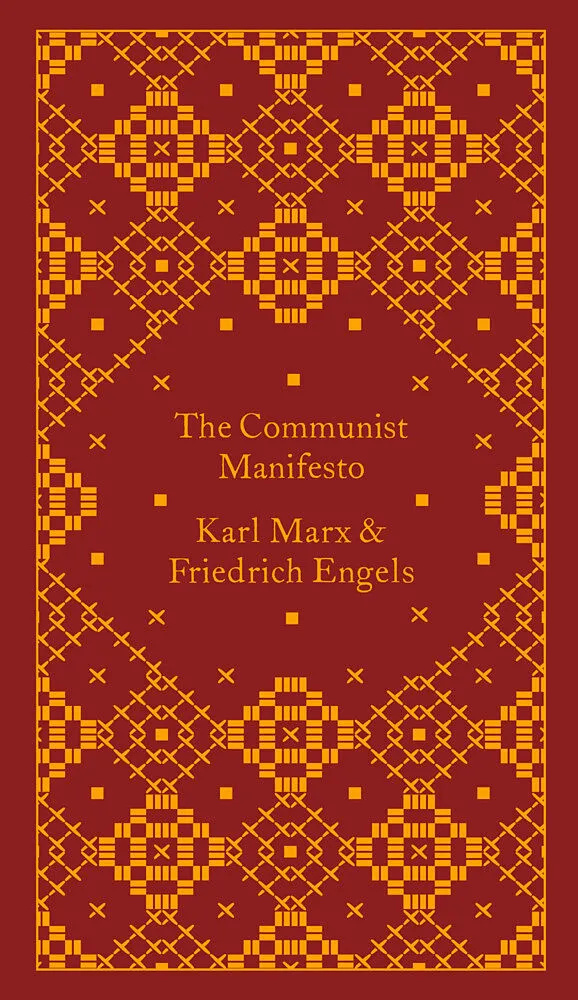
The Communist Manifesto
Beschreibung
A rousing call to arms whose influence is still felt today, Karl Marx and Friedrich Engels' The Communist Manifesto is edited with an introduction by Gareth Stedman-Jones in Penguin Classics. Marx and Engels's revolutionary summons to the working classes, The ...Format auswählen
- Fester EinbandCHF 25.90
- Kartonierter EinbandCHF 15.40
- E-Book (epub)CHF 6.00

Wird oft zusammen gekauft
Andere Kunden kauften auch
Beschreibung
A rousing call to arms whose influence is still felt today, Karl Marx and Friedrich Engels' The Communist Manifesto is edited with an introduction by Gareth Stedman-Jones in Penguin Classics. Marx and Engels's revolutionary summons to the working classes, The Communist Manifesto is one of the most important political theories ever formulated. After four years of collaboration, they produced an incisive account of their idea of Communism, in which they envisage a society without classes, private property or a state, arguing that the exploitation of industrial workers will eventually lead to a revolution in which Capitalism is overthrown. This vision provided the theoretical basis of political systems in Russia, China, Cuba and Eastern Europe, affecting the lives of millions. The Communist Manifesto still remains a landmark text: a work that continues to influence and provoke debate on capitalism and class. Gareth Stedman Jones's extensive and scholarly introduction provides an unique assessment of the place of The Communist Manifesto in history, and its continuing relevance as a depiction of global capitalism. This edition reproduces Samuel Moore's translation of 1888 and contains a guide to further reading, notes and an index. Karl Marx (1818-1883) was born in Trier, Germany and studied law at Bonn and Berlin. He settled in London, where he studied economics and wrote the first volume of his major work, Das Kapital (1867, with two further volumes in 1884 and 1894). He is buried in Highgate Cemetery, London. Friedrich Engels (1820-1895), as well as his collaboration with Marx, was the author of The Condition of the Working Class in England (1845), based on personal observations and research. If you enjoyed The Communist Manifesto , you might like Marx's Capital , also available in Penguin Classics. 'The words of the Communist Manifesto flare like the fiery writing on the wall above the crumbling bastions of capitalist society: socialism or barbarism! ' Rosa Luxemburg ...
Autorentext
**Karl Marx **was born in Trier, Germany and studied law at Bonn and Berlin. In 1848, with Freidrich Engels, he finalized The Communist Manifesto. He settled in London, where he studied economics and wrote the first volume of his major work, Das Kapital (1867, two further volumes were added in 1884 and 1894). He is buried in Highgate Cemetery, London.
**Friedrich Engels **was born in Westphalia in 1820, the son of a textile manufacturer. After military training in Berlin, Engels already a convert to communism, went to Manchester in 1842 to represent the family firm. A relationship with a mill-hand, Mary Bums, and friendship with local Owenites and Chartists helped to inspire his famous early work,* The Condition of the Working Class *in England in 1844. His collaboration with Marx began in 1844 and in 1847 he composed the first drafts of the Communist Manifesto. After playing an active part in the German revolutions, Engels returned to work in Manchester until 1870, when he moved to London. He not only helped Marx financially, but reinforced their shared position through his own expositions of the new theory. After Marx’s death, he prepared the unfinished volumes of Capital for publication. He died in London in 1895.
**Gareth Stedman Jones **is Professor of Political Science in the History Faculty of Cambridge University and a Fellow of King's College, Cambridge. He is also a Director of the Centre of History and Economics at Cambridge. His publications include *Outcast London *and Languages of Class.
Klappentext
Karl Marx and Friedrich Engels’ landmark text that continues to influence and provoke debate on capitalism and class, now in a stunning clothbound edition designed by Coralie Bickford-Smith.
The Communist Manifesto, Marx and Engels's revolutionary summons to the working classes, is one of the most important and influential political theories ever formulated. After four years of collaboration, the authors produced this incisive declaration of their idea of Communism, in which they envisage a society without classes, private property or a state. They argue that increasing exploitation of industrial workers will eventually lead to a revolution in which Capitalism is overthrown. This vision provided the theoretical basis of political systems in Russia, China, Cuba and Eastern Europe, affecting the lives of millions.
Penguin Classics is the leading publisher of classic literature in the English-speaking world, representing a global bookshelf of the best works throughout history and across genres and disciplines. Readers trust the series to provide authoritative texts enhanced by introductions and notes by distinguished scholars and contemporary authors, as well as up-to-date translations by award-winning translators.
Zusammenfassung
Provides the theoretical basis of political systems in Russia, China, Cuba and Eastern Europe, affecting the lives of millions. This book continues to influence and provoke debate on capitalism and class.
Leseprobe
MANIFESTO OF THE COMMUNIST PARTY
A SPECTRE is haunting Europe--the spectre of Communism. All the Powers of old Europe have entered into a holy alliance to exorcise this spectre: Pope and Czar, Metternich and Guizot, French Radicals and German police-spies.
Where is the party in opposition that has not been decried as Communistic by its opponents in power? Where the Opposition that has not hurled back the branding reproach of Communism, against the more advanced opposition parties, as well as against its reactionary adversaries?
Two things result from this fact.
I. Communism is already acknowledged by all European Powers to be itself a Power.
II. It is high time that Communists should openly, in the face of the whole world, publish their views, their aims, their tendencies, and meet this nursery tale of the Spectre of Communism with a Manifesto of the party itself.
To this end, Communists of various nationalities have assembled in London, and sketched the following Manifesto, to be published in the English, French, German, Italian, Flemish and Danish languages.
I. BOURGEOIS AND PROLETARIANS*
The history of all hitherto existing society is the history of class struggles.
Freeman and slave, patrician and plebeian, lord and serf, guild-master* and journeyman, in a word, oppressor and oppressed, stood in constant opposition to one another, carried on an uninterrupted, now hidden, now open fight, a fight that each time ended, either in a revolutionary re-constitution of society at large, or in the common ruin of the contending classes.
In the earlier epochs of history, we find almost everywhere a complicated arrangement of society into various orders, a manifold gradation of social rank. In ancient Rome we have patricians, knights, plebeians, slaves; in the Middle Ages, feudal lords, vassals, guild-masters, journeymen, apprentices, serfs; in almost all of these classes, again, subordinate gradations.
The modern bourgeois society that has sprouted from the ruins of feudal society has not done away with class antagonisms. It has but established new classes, new conditions of oppression, new forms of struggle in place of the old ones.
Our epoch, the epoch of the bourgeoisie, possesses, however, this distinctive feature: it has simplified the class antagonisms: Society as a whole is more and more splitting up into two great hostile camps, into two great classes directly facing each other: Bourgeoisie and Proletariat.
From the serfs of the Middle Ages sprang the chartered burghers of the earliest towns. From these burgesses the first elements of the bourgeoisie were developed.
The discovery of America, the rounding of the Cape, opened up fresh ground for the rising bourgeoisie. The East-Indian an…