Beschreibung
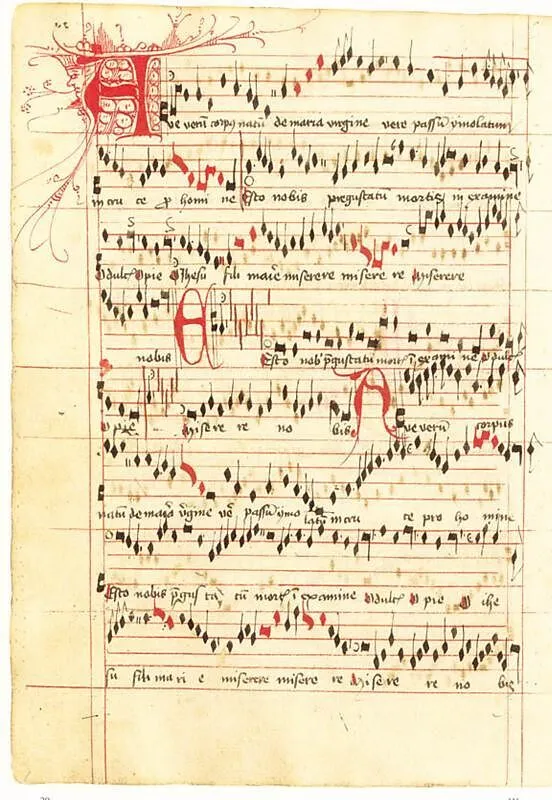
Der Mensuralcodex St. Emmeram ist eine der wichtigsten, wenn nicht die wichtigste Quelle zur Überlieferung der internationalen Mehrstimmigkeit in Mitteleuropa, die aus dem späten Mittelalter erhalten ist. Sie zeigt in besonderer Weise die allmähliche Akzeptanz...Der Mensuralcodex St. Emmeram ist eine der wichtigsten, wenn nicht die wichtigste Quelle zur Überlieferung der internationalen Mehrstimmigkeit in Mitteleuropa, die aus dem späten Mittelalter erhalten ist. Sie zeigt in besonderer Weise die allmähliche Akzeptanz des internationalen Stils im rückständigen Mitteleuropa.
Der Codex (Clm 14274 der Bayerischen Staatsbibliothek) ist eine Papierhandschrift und enthält etwa 280 ein- und mehrstimmige Musikstücke sowie einen Index. Er entstand etwa in den Jahren 1435-1443, wobei der größte Teil von dem Schulmeister und Büchersammler Hermann Pötzlinger eingetragen wurde. Pötzlinger hinterließ seine Bibliothek dem Kloster St. Emmeram in Regensburg, wo er unter anderem als Schulmeister wirkte. Im Zuge der Säkularisation 1812 gingen seine Bände zusammen mit der St. Emmeramer Klosterbibliothek in den Besitz der Königlich Baierischen Hof- und Centralbibliothek der heutigen Bayerischen Staatsbibliothek über.
Der Mensuralcodex St. Emmeram überliefert unter anderem große Teile des Werks von Guillaume Dufay, der wie kein anderer die musikalische Sprache Europas an der Wende vom Mittelalter zur Renaissance prägte. Weiterhin finden sich in der Sammlung Werke von Gilles Binchois und John Dunstable, aber auch Sätze von wenig bekannten Komponisten wie Hermann Edlerauer und Urbanus Kungsperger.
Das Faksimile enthält eine Einführung von Martin Staehelin (Universität Göttingen) sowie ein Kommentar von Ian Rumbold und Peter Wright (University of Nottingham), die den Codex und seinen Inhalt detailliert analysieren.
The 'St Emmeram Codex' (Munich, Bayerische Staatsbibliothek, Clm 14274) is one of the most important witnesses to the cultivation of international polyphonic music in Central Europe to have survived from the late Middle Ages. Among the oldest collections of polyphony from the German-speaking area, it demonstrates the widespread acceptance of progressive international styles
in a part of Europe that has sometimes been characterised
as a cultural backwater. The manuscript includes a substantial portion of the works of Guillaume Du Fay, who epitomises Western European style at the transition between the Middle Ages and the Renaissance better than any other composer. Binchois is also well represented, as are English composers of the period, including Benet, Dunstaple and Power. A number of local composers, many completely unknown from other sources, are also found in this manuscript, such as Hermann Edlerawer and Urbanus Kungsperger. Other works can be shown to have been composed in Central Europe, or to have reached Clm 14274 via a Central European tradition.
Clm 14274 is a folio paper manuscript of 13 gatherings plus a contemporary index. Its 158 folios contain 255 discrete musical items, nearly all of which are polyphonic. Apart from a few items that appear to have been copied in the early 1430s, it was assembled between about 1439 and about 1444. Of three distinguishable scribal layers, the first two were copied mostly by the original owner of the manuscript, Hermann Pötzlinger, with a number of assistants, the first layer in full notation, the second in void. Pötzlinger also compiled the original index, after which the third and final layer was added by a different hand, apparently that of a professional music scribe. Pötzlinger came from Bayreuth, studied at the University of Vienna from 1436 until at least 1439, and was schoolmaster at the Benedictine monastery of St Emmeram in Regensburg in and around 1450. At his death in 1469 he bequeathed his whole scholarly library of about 100 manuscripts to the monastery; in 1811 the monastery library was transferred to what is now the Bayerische Staatsbibliothek. 92 of Pötzlinger's manuscripts, including 56 that were at least partly copied by him, can still be identified there.
This fine colour facsimile, using the highest-standard digital techniques available, is accompanied by an introduction by Professor Martin Staehelin of the University of Göttingen and a scholarly commentary by Ian Rumbold with Peter Wright, both of the University of Nottingham, that provides a detailed codicological description of the manuscript and an analysis of its contents, together with a new inventory of the source. The introduction and commentary are being published in German and English.
Autorentext
Lorenz Welker is doctor of medicine, psychoanalyst and musicologist; since 1996 he is professor of musicology at the Ludwig-Maximilians-University in Munich. There, he is a member of the Human Science Centre and Director of the Zentrum Seniorenstudium.
His researches in historical musicology relate to the music of the late Middle Ages and the Baroque, questions of historical performance practice and interdisciplinary medieval studies. Furthermore, he is dedicated to questions concerning borderline areas between humanities and sciences, especially with respect to the biological basis of the making and perception of music.
In 1988, he was honoured with the E. Sigerist-Award of the Swiss Society for the History of Medicine and Sciences. In 1994, he was awarded the Dent-Medal of the Royal Musical Association and the International Musicological Society.
Zusammenfassung
"The publication of the codex in facsimile marks a first culmination point in drawing this work together. (...)
The 150-page commentary volume, in English and German, provides a atate-of-the-art guide to the source. The bulk of it presents the first fruits of Rumbold and Wright's collaborative research. Ever anticipated aspect is touched upon, with physical makeup, scribes and compilation receiving particularly thorough treatment. A brief introduction by Martin Staehlin succinctly highlights the most important aspects of the codex's significance, and an extensive bibliography is provided. (...)
An influx in English music, by Dunstaple and Power among others, in the later layers of the codex reflects larger contemporary trends. It is not the international repertory, however, but the local, that makes the codex uniquely valuable and distinctive. (...) More than 100 works, however, are both anonymous and unknown outside the codex. New insights into this easily sidelined repertory will be among the most interesting avenues for further research. (...)
The facsimile itself is superb. The dource is presented at its original size, and runs complete from inside front-cover to inside back-cover in full colour apart from four now-lost pages that had to be recovered from microfilm. The high resolution renders even the subtlest details visible. (...)
Along with its companion-studies, the facsimile will undoubtedly make the St Emmeram codex less easy to overlook than it has been in the past. Thanks to all involved, it is on its way to becoming a central European source in every sense."
David J. Burn
In: Early Music. XXXVII (2009) 2. pp. 311-313.
"Er ist eines der wichtigsten und umfangreichsten Denkmäler der mehrstimmigen Musik im deutschsprachigen Raum, das uns aus der ersten Hälfte des 15. Jahrhunderts erhalten ist." und: "Er ist die älteste Sammlung internationaler Mehrstimmigkeit im deutschen Sprachraum." Dr. Rolf Griebel, Generaldirektor der Bayerischen Staatsbibliothek, überschlug sich nur so mit Superlativen bei der Beschreibung des Mensuralcodex St. Emmeram.
Seit drei Jahrzehnten war es der Wunsch von Wissenschaft und Staatsbibliothek, ein hochwertiges Faksimile, das heißt eine originalgetreue Kopie, zu erstellen. Doch das Projekt scheiterte immer wieder an Finanzierungsfragen. Mit der Unterstützung durch die Oberfrankenstiftung kam aber der Durchbruch. Dazu gibt es einen deutschen und englischen Kommentar. Bei dem Reproduktionsverfahren wurde ausschließlich die digitale Technik angewandt. (...)
Der Mensuralcodex wurde von dem aus Bayreuth stammenden Lehrer und Pfarrer Hermann …
Tief- preis