
IHR WARENKORB IST AKTUELL LEER.
Haben Sie noch nichts passendes gefunden? Stöbern Sie durch unser komplettes Sortiment.
Oder melden Sie sich an bzw. registrieren Sie sich.
- Kostenlose Lieferung
- Kauf auf Rechnung
- Ex Libris Tiefpreis
- Filiallieferung und 650+ Abholorte
- Rabatt-Bons als Club-Mitglied
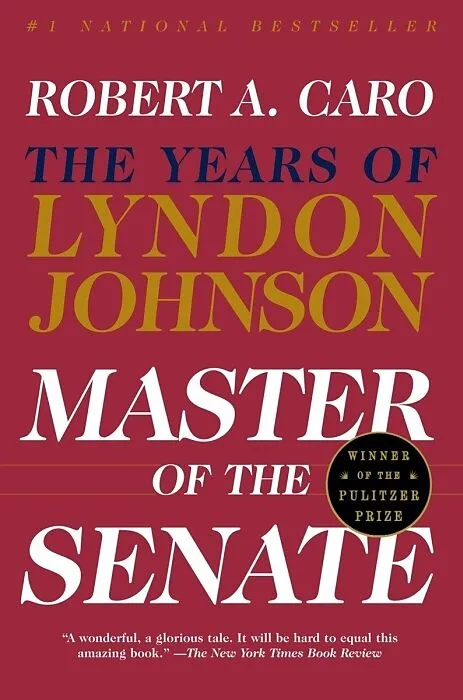
Master of the Senate
Beschreibung
Zusatztext 86075304 Informationen zum Autor Robert A. Caro Klappentext PULITZER PRIZE WINNER • Master of the Senate, Book Three of The Years of Lyndon Johnson, carries Johnson's story through one of its most remarkable periods: his twelve years, from 1949...Format auswählen
- BroschiertCHF 29.60

Wird oft zusammen gekauft
Andere Kunden kauften auch
Beschreibung
Zusatztext 86075304 Informationen zum Autor Robert A. Caro Klappentext PULITZER PRIZE WINNER • Master of the Senate, Book Three of The Years of Lyndon Johnson, carries Johnson's story through one of its most remarkable periods: his twelve years, from 1949 to 1960, in the United States Senate. A Los Angeles Times Best Nonfiction Book of the Last 30 Years At the heart of the book is its unprecedented revelation of how legislative power works in America, how the Senate works, and how Johnson, in his ascent to the presidency, mastered the Senate as no political leader before him had ever done. It was during these years that all Johnson's experiencefrom his Texas Hill Country boyhood to his passionate representation in Congress of his hardscrabble constituents to his tireless construction of a political machinecame to fruition. Caro introduces the story with a dramatic account of the Senate itself: how Daniel Webster, Henry Clay, and John C. Calhoun had made it the center of governmental energy, the forum in which the great issues of the country were thrashed out. And how, by the time Johnson arrived, it had dwindled into a body that merely responded to executive initiatives, all but impervious to the forces of change. Caro anatomizes the genius for political strategy and tactics by which, in an institution that had made the seniority system all-powerful for a century and more, Johnson became Majority Leader after only a single term-the youngest and greatest Senate Leader in our history; how he manipulated the Senate's hallowed rules and customs and the weaknesses and strengths of his colleagues to change the unchangeable Senate from a loose confederation of sovereign senators to a whirring legislative machine under his own iron-fisted control. Caro demonstrates how Johnson's political genius enabled him to reconcile the unreconcilable: to retain the support of the southerners who controlled the Senate while earning the trustor at least the cooperationof the liberals, led by Paul Douglas and Hubert Humphrey, without whom he could not achieve his goal of winning the presidency. He shows the dark side of Johnson's ambition: how he proved his loyalty to the great oil barons who had financed his rise to power by ruthlessly destroying the career of the New Dealer who was in charge of regulating them, Federal Power Commission Chairman Leland Olds. And we watch him achieve the impossible: convincing southerners that although he was firmly in their camp as the anointed successor to their leader, Richard Russell, it was essential that they allow him to make some progress toward civil rights. In a breathtaking tour de force, Caro details Johnson's amazing triumph in maneuvering to passage the first civil rights legislation since 1875. Master of the Senate, told with an abundance of rich detail that could only have come from Caro's peerless research, is both a galvanizing portrait of the man himselfthe titan of Capital Hill, volcanic, mesmerizingand a definitive and revelatory study of the workings and personal and legislative power.Chapter 1 The Desks of the Senate The Chamber of the United States Senate was a long, cavernous spaceover a hundred feet long. From its upper portion, from the galleries for citizens and journalists which rimmed it, it seemed even longer than it was, in part because it was so gloomy and dimso dim in 1949, when lights had not yet been added for television and the only illumination came from the ceiling almost forty feet above the floor, that its far end faded away in shadowsand in part because it was so pallid and bare. Its drab tan damask walls, divided into panels by tall columns and pilasters and by seven sets of double doors, were unrelieved by even a single touch of colorno painting, no muralor, seemingly, by any other ornament. Above those walls, in the galleries, were rows of se...
“A wonderful, a glorious tale. . . . It will be hard to equal this amazing book. It reads like a Trollope novel, but not even Trollope explored the ambitions and the gullibilities of men as deliciously as Robert Caro does. Even though I knew what the outcome of a particular episode would be, I followed Caro’s account of it with excitement. I went back over chapters to make sure I had not missed a word . . . Caro’s description of how [Johnson passed the civil rights legislation] is masterly; I was there and followed the course of the legislation closely, but I did not know the half of it.”
*—*Anthony Lewis, The New York Times Book Review
“A masterpiece . . . Robert Caro has written one of the truly great political biographies of the modern age.”
*—*Daniel Finkelstein, The Times (London)
“Mesmerizing. . . . [It] brings LBJ blazing into the Senate. . . . A tale rife with drama and hypnotic in the telling. The historian’s equivalent of a Mahler symphony.”
—Malcolm Jones, Newsweek
“Caro’s immersion in the man and period yields a fascinating, entertaining abundance . . . Master of the Senate splendidly reassembles the U.S. Senate of those years.”
—Time
“Brilliant . . . Caro achieves a special tension, too rare in history books but essential in epic poetry: the drama of a hero who is wrestling with his enemies, his limitations and his fate to achieve something truly lasting . . . In his hands, the obscure fight over legislation becomes nothing less than a battle for the soul of America . . . It’s a terribly important work, unblinkingly delineating the inner workings of our democracy.”
—Chicago Tribune
“An epic tale of winning and wielding power.”
—Dan DeLuca, Philadelphia Inquirer
“Caro must be America's greatest living Presidential biographer . . . He entrances us with both his words and his research . . . No other contemporary biographer offers such a complex picture of the forces driving an American politician, or populates his work with such vividly drawn secondary characters. Extraordinary.”
—Richard S. Dunham, BusinessWeek
“The most complete portrait of the Senate ever drawn.”
—Michael Wolff, New York
“A terrific study of power politics.”
—Steve Neal, *Chicago Sun-Times
- “In this fascinating book, Robert Caro does more than carry forward his epic life of Lyndon Johnson. With compelling narrative power and with remarkable subtlety and sensitivity, he illuminates the Senate of the United States and its byzantine power struggles. In this historical tour-de-force, Robert Caro shows himself the true 'master of the Senate.’”
—Arthur Schlesinger, Jr
“Master of the Senate and its two preceding volumes are the highest expression of biography as art. After The Path to Power and Means of Ascent, there shouldn’t be much debate about Caro's grand achievement, but let’s be clear about this nonetheless: In terms of political biography, not only does it not get better than this, it can’t.”
—Patrick Beach, Austin American-Statesman
“These [legislative battles] are great stories, the stuff of the legends of democracy—rich in character, plot, suspense, nuttiness, human frailty, maddening stupidity. These should be the American sagas; these should be our epics. Bob Caro has given us a beauty, and I think we owe him great thanks.”
—Molly Ivins, New York Observer
“Indefatigably researched and brilliantly written . . . Powerful . . . One of Caro’s most valuable contributions is his excavation of the lost art of legislating . . . Rich and rewarding.”
—Ronald Brownstein, Times Literary Supplement
“Epic . . . It is impossible to imag…