
IHR WARENKORB IST AKTUELL LEER.
Haben Sie noch nichts passendes gefunden? Stöbern Sie durch unser komplettes Sortiment.
Oder melden Sie sich an bzw. registrieren Sie sich.
- Kostenlose Lieferung
- Kauf auf Rechnung
- Ex Libris Tiefpreis
- Filiallieferung und 650+ Abholorte
- Rabatt-Bons als Club-Mitglied
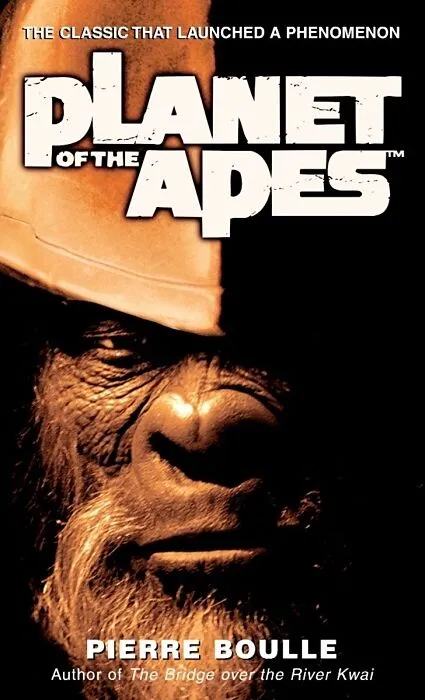
Planet of the Apes
Beschreibung
Informationen zum Autor Pierre Boulle was born in Avignon, France in 1912. He originally trained as an engineer, but in 1936 went to Malaysia as a rubber planter. In 1939 he was called up in the French forces in Indochina. When France fell during World War II,...Format auswählen
- TaschenbuchCHF 12.70

Wird oft zusammen gekauft
Andere Kunden kauften auch
Beschreibung
Informationen zum Autor Pierre Boulle was born in Avignon, France in 1912. He originally trained as an engineer, but in 1936 went to Malaysia as a rubber planter. In 1939 he was called up in the French forces in Indochina. When France fell during World War II, he fled to Singapore, where he joined the Free French Mission. After the Japanese invasion, he was sent via Rangoon and the Burma Road to Yunnan to establish contact with Kuomintang forces. He infiltrated Indochina as a guerilla where he was captured in 1943. He escaped in 1944, was picked up by a British plane, and served in the Special Forces in Calcutta for the rest of the war. His first novel published in the United States was The Bridge on the River Kwai . It was awarded the Prix Ste. Beuve in France, and led to the motion picture that received an amazing seven Academy Awards. He considered his subsequent books, of which Planet of the Apes is the most well-known, to be social fantasies. Klappentext The original novel that inspired the films! First published more than fifty years ago, Pierre Boulle's chilling novel launched one of the greatest science fiction sagas in motion picture history. In the not-too-distant future, three astronauts land on what appears to be a planet just like Earth, with lush forests, a temperate climate, and breathable air. But while it appears to be a paradise, nothing is what it seems. They soon discover the terrifying truth: On this world humans are savage beasts, and apes rule as their civilized masters. In an ironic novel of nonstop action and breathless intrigue, one man struggles to unlock the secret of a terrifying civilization, all the while wondering: Will he become the savior of the human race, or the final witness to its damnation? In a shocking climax that rivals that of the original movie, Boulle delivers the answer in a masterpiece of adventure, satire, and suspense.One Jinn and Phyllis were spending a wonderful holiday, in space, as far away as possible from the inhabited stars. In those days interplanetary voyages were an everyday occurrence, and interstellar travel not uncommon. Rockets took tourists to the wondrous sites of Sirius, or financiers to the famous stock exchanges of Arcturus and Aldebaran. But Jinn and Phyllis, a wealthy leisured couple, were distinguished in their cosmos for their originality and a few grains of poetry. They wandered over the universe for their pleasureby sail. Their ship was a sort of sphere with an envelopethe sailwhich was miraculously fine and light and moved through space propelled by the pressure of light-radiation. Such a machine, left to its own devices in the vicinity of a star (though far enough away for the field of gravity not to be too power- ful), will always move in a straight line in the opposite direction to the star; but since Jinn and Phyllis' stellar system contained three suns that were relatively close to one another, their vessel received rays of light along three different axes. Jinn had therefore conceived an extremely ingenious method of steering. His sail was lined inside with a series of black blinds that he could roll up or unroll at will, thus changing the effect of the light-pressure by modifying the reflecting power of certain sections. Furthermore, this elastic envelope could be stretched or contracted as the navigator pleased. Thus, when Jinn wanted to increase his speed, he gave it the biggest diameter possible. It would then take the blasts of radiation on an enormous surface and the vessel would hurtle through space at a furious velocity, which made his mate Phyllis quite dizzy. He would also be overcome by vertigo, and they would then cling passionately to each other, their gaze fixed on the mysterious and distant depths to which their flight propelled them. When, on the other hand, they wanted to slow down, Jinn pressed a button. The sail wou...
Klappentext
**The original novel that inspired the films!
** First published more than fifty years ago, Pierre Boulle’s chilling novel launched one of the greatest science fiction sagas in motion picture history.
In the not-too-distant future, three astronauts land on what appears to be a planet just like Earth, with lush forests, a temperate climate, and breathable air. But while it appears to be a paradise, nothing is what it seems.
They soon discover the terrifying truth: On this world humans are savage beasts, and apes rule as their civilized masters. In an ironic novel of nonstop action and breathless intrigue, one man struggles to unlock the secret of a terrifying civilization, all the while wondering: Will he become the savior of the human race, or the final witness to its damnation? In a shocking climax that rivals that of the original movie, Boulle delivers the answer in a masterpiece of adventure, satire, and suspense.
Leseprobe
One
Jinn and Phyllis were spending a wonderful holiday, in space, as far away as possible from the inhabited stars.
In those days interplanetary voyages were an everyday occurrence, and interstellar travel not uncommon. Rockets took tourists to the wondrous sites of Sirius, or financiers to the famous stock exchanges of Arcturus and Aldebaran. But Jinn and Phyllis, a wealthy leisured couple, were distinguished in their cosmos for their originality and a few grains of poetry. They wandered over the universe for their pleasure—by sail.
Their ship was a sort of sphere with an envelope—the sail—which was miraculously fine and light and moved through space propelled by the pressure of light-radiation. Such a machine, left to its own devices in the vicinity of a star (though far enough away for the field of gravity not to be too power- ful), will always move in a straight line in the opposite direction to the star; but since Jinn and Phyllis’ stellar system contained three suns that were relatively close to one another, their vessel received rays of light along three different axes. Jinn had therefore conceived an extremely ingenious method of steering. His sail was lined inside with a series of black blinds that he could roll up or unroll at will, thus changing the effect of the light-pressure by modifying the reflecting power of certain sections. Furthermore, this elastic envelope could be stretched or contracted as the navigator pleased. Thus, when Jinn wanted to increase his speed, he gave it the biggest diameter possible. It would then take the blasts of radiation on an enormous surface and the vessel would hurtle through space at a furious velocity, which made his mate Phyllis quite dizzy. He would also be overcome by vertigo, and they would then cling passionately to each other, their gaze fixed on the mysterious and distant depths to which their flight propelled them. When, on the other hand, they wanted to slow down, Jinn pressed a button. The sail would shrink until it became a sphere just big enough to contain them both, packed tightly together. The effect of the light became negligible, and this minute bubble, reduced to nothing more than its own inertia, seemed motionless, as though suspended in the void by an invisible thread. The young couple would spend rapturous idle hours in this reduced universe, erected on their own scale and for them alone, which Jinn compared to a becalmed sailing ship and Phyllis to the air bubble of the sea spider.
Jinn knew a number of other tricks, considered as the height of art by sailing cosmonauts: for example, making use of the shadows of the planets and certain satellites in order to change course. He imparted this skill to Phyllis, who was now almost as accomplished as he himself and often more daring. When she held the tiller, she would sometimes fire a broadside that swept them right to the borders of the stellar system, heedless of the resulting magnetic storm, which would start to upset the light-rays and to shake their skiff like a cockleshell. On two or three …