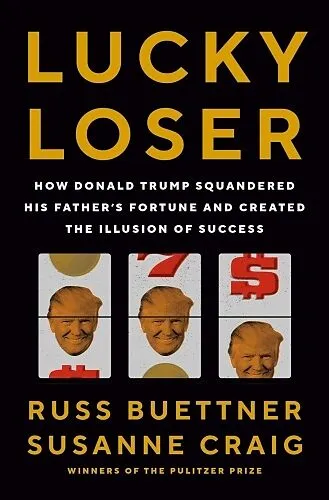
Lucky Loser
Beschreibung
From the Pulitzer Prize-winning reporters behind the 2018 bombshell Soon after announcing his first campaign for the US presidency, Donald J. Trump told a national television audience that life “has not been easy for me. It has not been easy for me.&rdqu...Format auswählen
- Fester EinbandCHF 34.90

Wird oft zusammen gekauft
Andere Kunden kauften auch
Beschreibung
From the Pulitzer Prize-winning reporters behind the 2018 bombshell Soon after announcing his first campaign for the US presidency, Donald J. Trump told a national television audience that life “has not been easy for me. It has not been easy for me.” Building on a narrative he had been telling for decades, he spun a hardscrabble fable of how he parlayed a small loan from his father into a multi-billion-dollar business and real estate empire. This feat, he argued, made him singularly qualified to lead the country.;Except: None of it was true. Born to a rich father who made him the beneficiary of his own highly lucrative investments, Trump received the equivalent of more than $500 million today via means that required no business expertise whatsoever. Drawing on over twenty years’ worth of Trump’s confidential tax information, including the tax returns he tried to conceal, alongside business records and interviews with Trump insiders, A masterpiece of narrative reporting, <Lucky Loser< is a meticulous, nearly-century spanning narrative, filled with scoops from Trump Tower, Mar-a-Lago, Atlantic City, and the set of The Apprentice. At a moment when Trump’s tether to success and power is more precarious than ever, here for the first time is the definitive true accounting of Trump and his money – what he had, what he lost, and what he has left – and the final word on the myth of Trump, the self-made billionaire....
Autorentext
Russ Buettner and Susanne Craig
Klappentext
An Instant New York Times Bestseller • A Washington Post Notable Book • A Financial Times Best Business Book of the Year
“A first-rate financial thriller . . . Lucky Loser is one of those rare Trump books that deserve, even demand, to be read.” —Alexander Nazaryan, The New York Times
From the Pulitzer Prize–winning reporters behind the 2018 bombshell New York Times exposé of President Trump’s finances, an explosive investigation into the history of Donald Trump’s wealth, revealing how one of the country’s biggest business failures lied his way into the White House
Soon after announcing his first campaign for the U.S. presidency, Donald J. Trump told a national television audience that life “has not been easy for me. It has not been easy for me.” Building on a narrative he had been telling for decades, he spun a hardscrabble fable of how he parlayed a small loan from his father into a multibillion-dollar business and real estate empire. This feat, he argued, made him singularly qualified to lead the country. Except none of it was true. As his wealthy father’s chosen successor, Trump received the equivalent today of more than $500 million in family money. He collected a second windfall thanks to Mark Burnett, the revolutionary television producer who made Trump a star. In truth, Trump’s empire was underwritten, and at times saved, by the equivalent of more than $1 billion that came his way without any of the business expertise he claimed.
Drawing on more than twenty years’ worth of Trump’s confidential tax information, including the tax returns he tried to conceal, alongside business records and interviews with Trump insiders, New York Times investigative reporters Russ Buettner and Susanne Craig track Trump’s financial rise and fall, and rise and fall again. A masterpiece of narrative reporting, Lucky Loser is a meticulous examination spanning nearly a century, filled with scoops from Trump Tower, Mar-a-Lago, Atlantic City, and the set of The Apprentice. Here for the first time is the definitive true accounting of Trump and his money—what he had, what he lost, and what he has left—and the myth of Trump, the self-made billionaire, exposed.
Leseprobe
In May 1923, a determined seventeen-year-old boy stared out from a page of The Brooklyn Daily Eagle. Above his thick blond hair ran the headline helps build queens. Two paragraphs announced to the world that this teenager, Fred C. Trump, envisioned “a big future in the building industry.” He would become a “builder,” he declared.
The borough of Queens was exploding with growth all around him. The population had roughly tripled since his birth and would double again by 1930. His alma mater—Richmond Hill High School—had been built for eight hundred students but was already jammed with two thousand teenagers. Classes were held on the front steps. Students waited in line for a desk in the study hall.
Outside, the streets teamed with new arrivals, mostly from Germany and Russia. The demand for housing was unyielding. It was a time when a paved street and a sewer line were luxuries notable enough to mention in an advertisement. Former farms and forests in Queens offered vast stretches of open land, newly within reach of Manhattan. After the Queensboro Bridge had connected the boroughs in 1909, train lines and trollies pushed farther and farther out. Real estate developers rushed to the site of each new train stop and advertised homes to Manhattan-bound commuters: “5-cent fare zone!” 
Amid this epic building boom, Fred Trump worked incessantly to find his place. He ignored his school’s extracurricular activities—the sports teams, the acting and singing troupes, the chapter of Arista, an honor society. Instead, he worked, earning money and learning how to build homes. He delivered building supplies to construction sites with a horse-drawn wagon. He took a job as an assistant foreman with a construction company. He eventually built a garage for a neighbor. He would come to believe that even his choice of childhood toys—blocks and erector sets—foretold his destiny.
In some measure, his interest in real estate tracked the unfulfilled dreams of his late father. His parents, Frederick and Elizabeth, had arrived from Germany during an earlier immigration wave, in the late 1800s. Frederick traveled to the western frontier, where he ran a restaurant that had once also operated as a brothel. He returned to New York City to manage a restaurant and pursue small real estate investments. He bought his young family a simple two- tory house on a dirt road in the Woodhaven section of Queens, one block south of the bustling Jamaica Plank Road, then a key route packed with horse- drawn carriages making the journey to Manhattan from the farms of Long Island. Their neighbors mostly rented their homes and worked as janitors, house painters, store clerks, and in the shipyard.
Frederick’s real estate career had just begun to gain momentum when he was struck down by the Spanish flu, the pandemic then ravaging the world. He died in 1918 at the age of forty- nine, leaving Elizabeth alone to raise their three children: Fred, twelve, John, ten, and Elizabeth, fourteen. They would not be destitute. Frederick left his wife an estate valued at $36,000, the equivalent of more than $800,000 today, mostly in the form of money due on loans he had made to builders and the value of a few vacant lots.
Elizabeth assumed the role of the family’s business leader. While Fred was still in high school, his mother hired contractors and oversaw the building of homes on the vacant lots she owned. She had designs on creating a family real estate company with her three children. John, who had a way with figures and details, would become the architect. Elizabeth, her oldest, would run the office. And Fred would become the builder. She formed the first Trump family enterprise, E. Trump & Son, artfully masking her own gender and her two sons’ youth.
Fred threw himself into the role. He took classes at a local YMCA in carpentry, and more classes to understand blueprints and eng…