
IHR WARENKORB IST AKTUELL LEER.
Haben Sie noch nichts passendes gefunden? Stöbern Sie durch unser komplettes Sortiment.
Oder melden Sie sich an bzw. registrieren Sie sich.
- Kostenlose Lieferung
- Kauf auf Rechnung
- Ex Libris Tiefpreis
- Filiallieferung und 650+ Abholorte
- Rabatt-Bons als Club-Mitglied
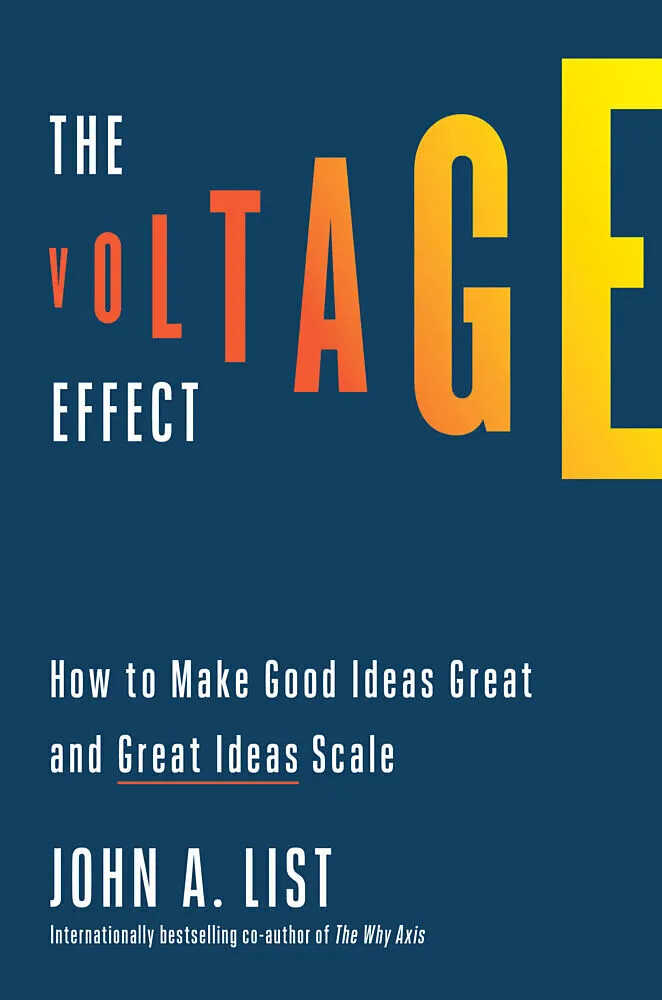
The Voltage Effect
Beschreibung
Nominiert: Porchlight Business Book Awards - Big Ideas and New Perspectives, 2022. “Skillfully done . . . Careful, comprehensive, and fun, The Voltage Effect excels in turning a seemingly boring niche topic into a fascinating book that’s relevant t...Format auswählen
- Kartonierter EinbandCHF 25.90

Wird oft zusammen gekauft
Andere Kunden kauften auch
Beschreibung
Nominiert: Porchlight Business Book Awards - Big Ideas and New Perspectives, 2022.
“Skillfully done . . . Careful, comprehensive, and fun, The Voltage Effect excels in turning a seemingly boring niche topic into a fascinating book that’s relevant to all, from CEOs and policymakers to naturally curious people with a taste for learning how economics shapes our lives in the real world.”—ZME Science
“If you’ve ever wondered why so many promising solutions fail to achieve their desired impact, look no further. . . . A master class in how the quirks of human irrationality can make or break our ideas in the real world.”—Steven D. Levitt, professor of economics, University of Chicago, and co-author of Freakonomics
“Brilliant, practical, and grounded in the very latest research, this is by far the best book I’ve ever read on the how and why of scaling. If you care about changing the world, or just want to make better decisions in your own life, The Voltage Effect is for you.”—Angela Duckworth, CEO of Character Lab and New York Times bestselling author of Grit
**
“How many books are funny and wise, practical and profound? John List is a scientist, but he’s also a magician, and he’s changing the world. The Voltage Effect shows how. This is one of the best economics books I have ever read—and an instant classic in behavioral economics.”—Cass R. Sunstein, Robert Walmsley University Professor, Harvard University, and New York Times bestselling co-author of Nudge**
“The Voltage Effect is the tool kit for the ambitious. Packed with proven principles and pro tips made real through behind-the-scenes stories in settings ranging from Silicon Valley to African NGOs, it fills the gap between startup books and management books to show how any idea can achieve its full potential.”—Scott Cook, co-founder of Intuit
“A must-read . . . Ideas from the ivory tower or Davos fail often—and fail badly—because they do not recognize the deeply political and historical nature of the problems they are meant to deal with or the social realities in which these problems are embedded. This thought-provoking and engaging book proposes an original framework for thinking about how good policy proposals can be applied at a scale large enough to do social good, and for avoiding predictable mistakes that prevent such scaling.”—Daron Acemoglu, professor at MIT and co-author of Why Nations Fail and The Narrow Corridor
“John List’s work in field experiments is revolutionary.”—Gary Becker, professor of economics and sociology, University of Chicago, Nobel Prize for Economics
Autorentext
John A. List
Klappentext
NATIONAL BESTSELLER • A leading economist answers one of today’s trickiest questions: Why do some great ideas make it big while others fail to take off?
“Brilliant, practical, and grounded in the very latest research, this is by far the best book I’ve ever read on the how and why of scaling.”—Angela Duckworth, CEO of Character Lab and New York Times bestselling author of Grit
LONGLISTED FOR THE PORCHLIGHT BUSINESS BOOK AWARD
“Scale” has become a favored buzzword in the startup world. But scale isn't just about accumulating more users or capturing more market share. It's about whether an idea that takes hold in a small group can do the same in a much larger one—whether you’re growing a small business, rolling out a diversity and inclusion program, or delivering billions of doses of a vaccine.
Translating an idea into widespread impact, says University of Chicago economist John A. List, depends on one thing only: whether it can achieve “high voltage”—the ability to be replicated at scale.
In The Voltage Effect, List explains that scalable ideas share a common set of attributes, while any number of attributes can doom an unscalable idea. Drawing on his original research, as well as fascinating examples from the realms of business, policymaking, education, and public health, he identifies five measurable vital signs that a scalable idea must possess, and offers proven strategies for avoiding voltage drops and engineering voltage gains. You’ll learn:
• How celebrity chef Jamie Oliver expanded his restaurant empire by focusing on scalable “ingredients” (until it collapsed because talent doesn’t scale)
• Why the failure to detect false positives early on caused the Reagan-era drug-prevention program to backfire at scale
• How governments could deliver more services to more citizens if they focused on the last dollar spent
• How one education center leveraged positive spillovers to narrow the achievement gap across the entire community
• Why the right set of incentives, applied at scale**,** can boost voter turnout, increase clean energy use, encourage patients to consistently take their prescribed medication, and more.
By understanding the science of scaling, we can drive change in our schools, workplaces, communities, and society at large. Because a better world can only be built at scale.
Leseprobe
**Part One
CAN YOUR IDEA SCALE?
1
Dupers and False Positives**
On September 14, 1986, First Lady Nancy Reagan appeared on national television to address the nation from the West Sitting Hall of the White House. She sat on a sofa next to her husband, President Ronald Reagan, and gazed into the camera. “Today there’s a drug and alcohol abuse epidemic in this country and no one is safe from it,” she said. “Not you, not me, and certainly not our children.”
This broadcast was the culmination of all the traveling the First Lady had done over the preceding five years to raise awareness among American youth about the dangers of drug use. She had become the public face of the preventative side of President Reagan’s War on Drugs, and her message hinged on a catchphrase that millions of people still remember, which she employed once again that evening on television. “Not long ago, in Oakland, California,” Nancy Reagan told viewers, “I was asked by a group of children what to do if they were offered drugs. And I answered, ‘Just say no.’ ”
Although there are different accounts of where this infamous slogan originated—with an academic study, an advertising agency, or the First Lady herself—its “stickiness,” to use the parlance of marketing, was undeniable. The phrase appeared on billboards, in pop songs, and on television shows; school clubs took it as a name. And in the popular imagination it became inseparable from what government and law enforcement officials saw as the crown jewel of the Reagan-era drug prevention campaign: Drug Abuse Resistance Education, or D.A.R.E.
In 1983, Los Angeles chief of police Daryl Gates announced a shift in his department’s approach to the War on Drugs: instead of busting kids in possession of illegal substances, the new focus would be on preventing those drugs from getting into their hands in the first place. This was how D.A.R.E., with its iconic logo of red letters set against a black background, was born.
D.A.R.E. was an educational program built on a theory from psychology called social inoculation, which took from epidemiology the concept of vaccination—administering a small dose of an infectious agent to induce immunity—and applied it to human…