Faust 1
Beschreibung
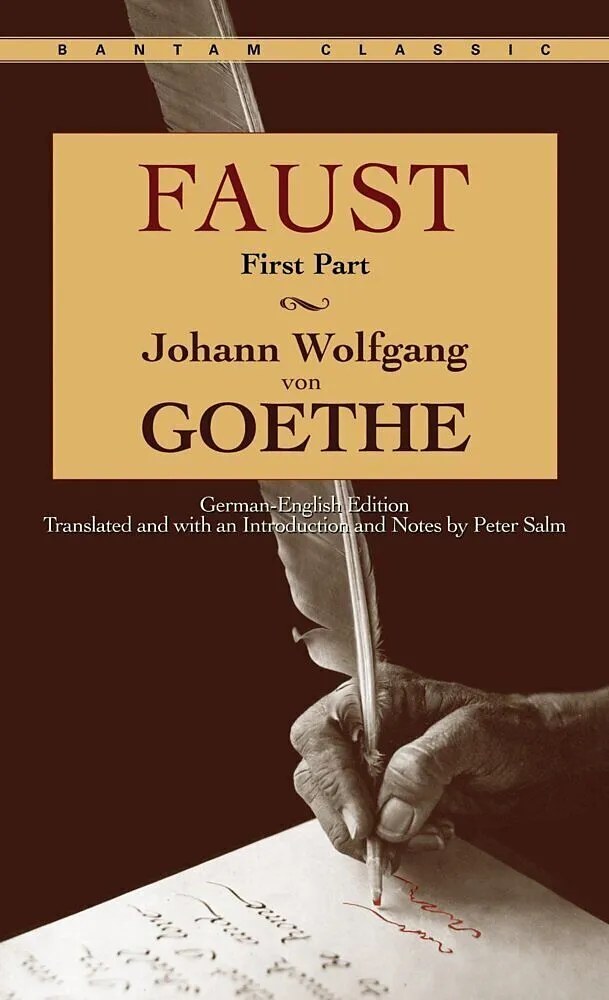
Goethe's masterpiece and perhaps the greatest work in German literature, "Faust has made the legendary German alchemist one of the central myths of the Western world. Here indeed is a monumental Faust, an audacious man boldly wagering with the devil,...Format auswählen
- Kartonierter EinbandCHF 10.55

Wird oft zusammen gekauft
Andere Kunden kauften auch
Beschreibung
Goethe's masterpiece and perhaps the greatest work in German literature, "Faust has made the legendary German alchemist one of the central myths of the Western world. Here indeed is a monumental Faust, an audacious man boldly wagering with the devil, Mephistopheles, that no magic, sensuality, experience or knowledge can lead him to a moment he would wish to last forever. Here, in "Faust, "Part 1, the tremendous versatility of Goethe's genius creates some of the most beautiful passages in literature. Here too we experience Goethe's characteristic humor, the excitement and eroticism of the witches' Walpurgis Night, and the moving emotion of Gretchen's tragic fate.
This newly revised edition, which offers Peter Salm's wonderfully readable translation as well as the original German on facing pages, brings us "Faust in a vital, rhythmic American idiom that carefully preserves the grandeur, integrity, and poetic immediacy of Goethe's words.
Autorentext
Before he was thirty, Goethe had proven himself a master of the novel, the drama, and lyric poetry. But even more impressive than his versatility was his unwillingness ever to settle into a single style or approach; whenever he used a literary form, he made of it something new.
Born in 1749 to a well-to-do family in Frankfurt, he was sent to Strasbourg to earn a law degree. There, he met the poet-philosopher Herder, discovered Shakespeare, and began to write poetry. His play Götz von Berlichingen (1773) made him famous throughout Germany. He was invited to the court of the duke of Sachsen-Weimar, where he quickly became a cabinet minister. In 1774 his novel of Romantic melancholy, The Sorrows of a Young Werther, electrified all of Europe. Soon as he was at work on the first version of his Faust, which would finally appear as a fragment in 1790.
In the 1780s Goethe visited England and immersed himself in classical poetry. The next decade saw the appearance of Wihelm Meister’s Apprenticeship, his novel of a young artist education, and a wealth of poetry and criticism. He returned to the Faust material around the turn of the century and completed Part 1 in 1808.
The later years of his life were devoted to a bewildering array of pursuits: research in botany and in a theory of colors, a novel (Elective Affinities), the evocative poems of the West-Easters Divan, and his great autobiography, Poetry and Truth. In his eighties he prepared a forty-volume edition of his works; the forty-first volume, published after his death in 1832, was the send part of Faust.
Goethe’s wide-ranging mind could never be confined to one form or one philosophy. When asked for the theme of his masterwork, Faust, he could only say. “From heaven through all the world to hell”; his subject was nothing smaller.
Klappentext
Goethe's masterpiece and perhaps the greatest work in German literature, Faust has made the legendary German alchemist one of the central myths of the Western world. Here indeed is a monumental Faust, an audacious man boldly wagering with the devil, Mephistopheles, that no magic, sensuality, experience, or knowledge can lead him to a moment he would wish to last forever. Here, in Faust**, Part I, the tremendous versatility of Goethe's genius creates some of the most beautiful passages in literature. Here too we experience Goethe's characteristic humor, the excitement and eroticism of the witches' Walpurgis Night, and the moving emotion of Gretchen's tragic fate.
This authoritative edition, which offers Peter Salm's wonderfully readable translation as well as the original German on facing pages, brings us Faust in a vital, rhythmic American idiom that carefully preserves the grandeur, integrity, and poetic immediacy of Goethe's words.
Leseprobe
Dedication One
Wavering forms, you come again;
once long ago you passed before my clouded sight.
Should I now attempt to hold you fast?
Does my heart still look for phantoms?
You surge at me! Well, then you may rule
as you rise about me out of mist and cloud.
The airy magic in your path
stirs youthful tremors in my breast.
You bear the images of happy days,
and friendly shadows rise to mind.     
With them, as in an almost muted tale,
come youthful love and friendship.
The pain is felt anew, and the lament
sounds life's labyrinthine wayward course
and tells of friends who went before me
and whom fate deprived of joyous hours.
They cannot hear the songs which follow,
the souls to whom I sang my first,
scattered is the genial crowd,
the early echo, ah, has died away.     
Now my voice sings for the unknown many
whose very praise intimidates my heart.
The living whom my song once charmed
are now dispersed throughout the world.
And I am seized by long forgotten yearnings
for the solemn, silent world of spirits;
as on an aeolian harp my whispered song
lingers now in vagrant tones.
I shudder, and a tear draws other tears;
my austere heart grows soft and gentle.
What I possess appears far in the distance,
and what is past has turned into reality.
-
Prelude in the Theater
Manager, Dramatic Poet, Comic Character.* -
Manager*
You two who often stood by me
in times of hardship and of gloom,
what do you think our enterprise
should bring to German lands and people?
I want the crowd to be well satisfied,
for, as you know, it lives and lets us live.
The boards are nailed, the stage is set,
and all the world looks for a lavish feast.    
There they sit, with eyebrows raised,
and calmly wait to be astounded.
I have my ways to keep the people well disposed,
but never was I in a fix like this.
It's true, they're not accustomed to the best,
yet they have read an awful lot of things.
How shall we plot a new and fresh approach
and make things pleasant and significant?
I'll grant, it pleases me to watch the crowds,
as they stream and hustle to our tent  
and with mighty and repeated labors
press onward through the narrow gate of grace;
while the sun still shines--it's scarcely four o'clock--
they fight and scramble for the ticket window,
and as if in famine begging at the baker's door,
they almost break their necks to gain admission.The poet alone can work this miracle
on such a diverse group. My friend, the time is now! -
Poet*
Oh, speak no more of motley crowds to me,
their presence makes my spirit flee.   
Veil from my sight those waves and surges
that suck us down into their raging pools.
Take me rather to a quiet little cell
where pure delight blooms only for the poet,
where our inmost joy is blessed and fostered
by love and friendship and the hand of God.
Alas! What sprang from our deepest feelings,
what our lips tried timidly to form,
failing now and now perhaps succeeding,
is devoured by a single brutish moment. 70
Often it must filter through the years
before its final form appears perfected.
What gleams like tinsel is but for the moment.
What's true remains intact for future days.Comedian
Oh, save me from such talk of future days!
Suppose I were concerned with progeny,
then who would cheer our present generation?
It lusts for fun and should be gratified.
A fine young fellow in the present tense
is worth a lot when all is said and done.      
If he can charm and make the public feel at ease,
he will not mind its changing moods;
he seeks the widest circle for himself,
so that his act will thereby be more telling.
And now be smart and show your finest qualities,
let fantasy be heard with all its many voices.Manager
Above all, let there be sufficient action!
They come to gaze and w…