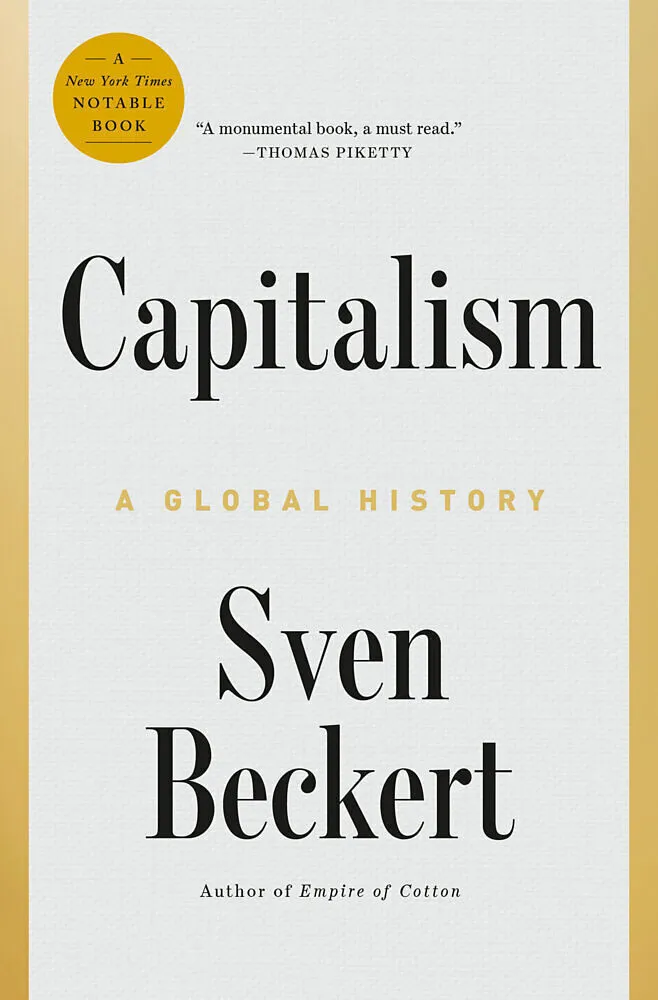
Capitalism
Beschreibung
A landmark event eight years in the making, a brilliant global narrative that unravels the defining story of the past thousand years of human history Sven Beckert, founder of Harvard’s Program on the Study of Capitalism, has made a profound impact on...Format auswählen
- Fester EinbandCHF 46.70

Wird oft zusammen gekauft
Andere Kunden kauften auch
Beschreibung
A landmark event eight years in the making, a brilliant global narrative that unravels the defining story of the past thousand years of human history
Sven Beckert, founder of Harvard’s Program on the Study of Capitalism, has made a profound impact on his field, including his Bancroft-Prize-winning history, <Empire of Cotton<. That was merely base camp for the epic achievement of his new book. Capitalism, Beckert argues, was born global. Emerging from interconnected nodes in Asia, Africa, and Europe and at first dominated by Arab traders, capitalism rooted itself gradually, persisting for centuries as a vital but limited circulatory system that left most of the world’s economic life untouched.
But then it burst onto the world scene, as European states and merchants built a powerful alliance that propelled them across the oceans. This, Beckert shows, was modern capitalism’s big bang, and its epicenter was the Caribbean. Europeans violently transformed tropical islands into slave labor camps, built with unparalleled efficiency and brutality to produce the world’s most valuable commodities. This system, with its hierarchies that haunt us still, provided the lift-off for the even more radical transformations of the Industrial Revolution. Empowered by vast productivity increases, capitalism pulled down old ways of life and expanded its orbit ever further. Gorging on coal and then oil, it erased earlier traditions and crowned itself the defining force of the modern world.
This epic drama corresponded at no point to an idealized dream of free markets. All along, state-backed institutions and imperial expansions shaped its dynamics, never more than when the system reached its worst crack-up ever in the two world wars and the Great Depression. In the aftermath, anti-colonial rebellions stripped capitalism of its European flavor to create the multipolar world we live in today. Drawing on archives on five continents, <Capitalism< decenters the European perspective, locating important modes of agency, resistance, innovation, and ruthless coercion everywhere in the world, including India, Japan, Africa, and the Americas, through to the present with China’s rise. Beckert opens the aperture from heads of state to rural cultivators to show that constant struggle is at the core of the capitalist revolution. Despite its dependence on expansion, there always have been, and are still, areas of human life it has yet to reach.
By peeling back the layers of capitalism’s global history, Beckert exposes the reality of the system that to us now seems simply “natural.” It is said that people can more easily imagine the end of the world than the end of capitalism. If there is one ultimate lesson in this extraordinary book, it’s how to leave that behind. Capitalism is nothing if not a human invention, and so is the ideology that cloaks itself in a false, timeless universality. Sven Beckert doesn’t merely tote up capitalism’s debits and credits. He shows us how to look through and beyond our reigning metaphor to imagine a larger world of survival, possibility and freedom....
Autorentext
Sven Beckert is the Laird Bell Professor of History at Harvard University. Holding a PhD from Columbia University, he has written widely on the economic, social, and political history of capitalism. His book Empire of Cotton won the Bancroft Prize, was a finalist for the Pulitzer Prize, and was named one of the ten best books of the year by The New York Times. An elected member of the American Academy of Arts and Sciences, he lives in Cambridge, Massachusetts.
Klappentext
*A New York Times* Notable Book
"A learned, formidable and vivid story… Readers around the world will study and ponder this monumental work of history, agreeing and arguing with it, all the while affirming its generational importance, for decades to come." — Marcus Rediker, The New York Times
A landmark event years in the making, a brilliant global narrative that unravels the defining story of the past thousand years of human history**
No other phenomenon has shaped human history as decisively as capitalism. It structures how we live and work, how we think about ourselves and others, how we organize our politics. Sven Beckert, author of the Bancroft Prize–winning Empire of Cotton, places the story of capitalism within the largest conceivable geographical and historical framework, tracing its history during the past millennium and across the world. An epic achievement, his book takes us into merchant businesses in Aden and car factories in Turin, onto the terrifyingly violent sugar plantations in Barbados, and within the world of women workers in textile factories in today’s Cambodia.
Capitalism, argues Beckert, was born global. Emerging from trading communities across Asia, Africa, and Europe, capitalism’s radical recasting of economic life rooted itself only gradually. But then it burst onto the world scene, as a powerful alliance between European states and merchants propelled them, and their economic logic, across the oceans. This, Beckert shows, was modern capitalism’s big bang, and one of its epicenters was the slave labor camps of the Caribbean. This system, with its hierarchies that haunt us still, provided the liftoff for the radical transformations of the Industrial Revolution. Fueled by vast productivity increases along with coal and oil, capitalism pulled down old ways of life to crown itself the defining force of the modern world. This epic drama, shaped by state-backed institutions and imperial expansion, corresponded at no point to an idealized dream of free markets.
Drawing on archives on six continents, Capitalism locates important modes of agency, resistance, innovation, and ruthless coercion everywhere in the world, opening the aperture from heads of state to rural cultivators. Beckert shows that despite the dependence on expansion, there always have been, and are still, areas of human life that the capitalist revolution has yet to reach.
By chronicling capitalism’s global history, Beckert exposes the reality of the system that now seems simply “natural.” It is said that people can more easily imagine the end of the world than the end of capitalism. If there is one ultimate lesson in this extraordinary book, it’s how to leave that behind. Though cloaked in a false timelessness and universality, capitalism is, in reality, a recent human invention. Sven Beckert doesn’t merely tote up capitalism’s debits and credits. He shows us how to look through and beyond it to imagine a different and larger world.
Leseprobe
1.
Islands of Capital
It is impossible to pinpoint an exact place or moment when capitalism began. Capitalism is a process, not a discrete historical event with a beginning and an end, and it did not drop fully formed into a particular location. Even today, no society is organized along fully capitalist lines, and some have argued that a fully capitalist world is a theoretical impossibility. Efforts to isolate one patch of soil as capitalism’s place of origin—​Florence, Barbados, Amsterdam, Baghdad, the southern English countryside, or Manchester, for example—​have all proved insufficient. That is because the capitalist revolution had always been a process that drew energy from myriad sources. The first springs fed into rivulets that over time became meandering and ever more powerful streams. As these streams moved through time and space, they encountered a world often hostile to their further development—​rivulets dried out; brooks met sandbanks and evaporated; and even the mightiest…