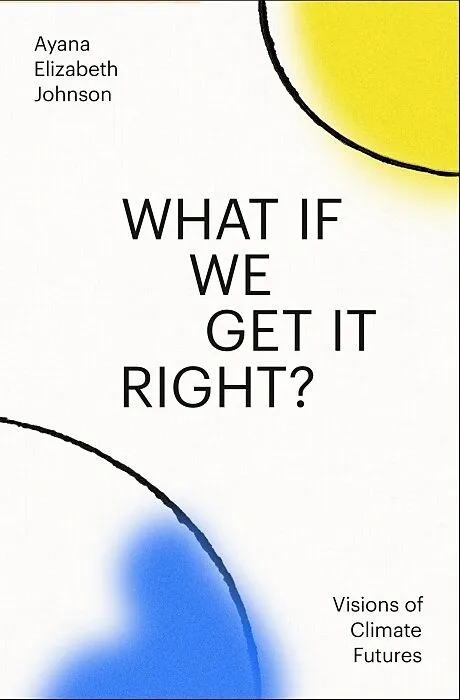
What If We Get It Right?
Beschreibung
Our climate future is not yet written. What if we act as if we love the future? Sometimes the bravest thing we can do while facing an existential crisis is imagine life on the other side. This provocative and joyous book maps an inspiring landscape of possible...Format auswählen
- Fester EinbandCHF 32.75

Wird oft zusammen gekauft
Andere Kunden kauften auch
Beschreibung
Our climate future is not yet written. What if we act as if we love the future?
Sometimes the bravest thing we can do while facing an existential crisis is imagine life on the other side. This provocative and joyous book maps an inspiring landscape of possible climate futures.
Through clear-eyed essays and vibrant conversations, infused with data, poetry, and art, Ayana Elizabeth Johnson guides us through solutions and possibilities at the nexus of science, policy, culture, and justice. Visionary farmers and financiers, architects and advocates, help us conjure a flourishing future, one worth the effort it will take—from every one of us, with whatever we have to offer—to create.
If you haven’t yet been able to picture a transformed and replenished world—or to see yourself, your loved ones, and your community in it—this book is for you. If you haven’t yet found your role in shaping this new world or you’re not sure how we can actually get there, this book is for you.
With grace, humor, and humanity, Johnson invites readers to ask and answer this ultimate question together: What if we get it right?
On imagination, possibility, and transformation with
Paola Antonelli • Xiye Bastida & Ayisha Siddiqa • Jade Begay • Régine Clément • Abigail Dillen • Brian Donahue • Kelly Sims Gallagher • Rhiana Gunn-Wright • K. Corley Kenna • Bryan C. Lee Jr. & Kate Orff • Franklin Leonard & Adam McKay • Bill McKibben • Kate Marvel • Samantha Montano • Leah Penniman • Colette Pichon Battle • Kendra Pierre-Louis • Judith D. Schwartz • Jigar Shah • Bren Smith • Oana Stănescu • Mustafa Suleyman...
Autorentext
Ayana Elizabeth Johnson
Klappentext
**NEW YORK TIMES BESTSELLER • “With a thoughtfully curated series of essays, poetry, and conversations, the brilliant scientist and climate expert Ayana Elizabeth Johnson has assembled a group of dynamic people who are willing to imagine what seems impossible, and articulate those visions with enthusiastic clarity.”—Roxane Gay
Our climate future is not yet written. What if we act as if we love the future?**
A SMITHSONIAN BEST BOOK OF THE YEAR
Sometimes the bravest thing we can do while facing an existential crisis is imagine life on the other side. This provocative and joyous book maps an inspiring landscape of possible climate futures.
Through clear-eyed essays and vibrant conversations, infused with data, poetry, and art, Ayana Elizabeth Johnson guides us through solutions and possibilities at the nexus of science, policy, culture, and justice. Visionary farmers and financiers, architects and advocates, help us conjure a flourishing future, one worth the effort it will take—from every one of us, with whatever we have to offer—to create.
If you haven’t yet been able to picture a transformed and replenished world—or to see yourself, your loved ones, and your community in it—this book is for you. If you haven’t yet found your role in shaping this new world or you’re not sure how we can actually get there, this book is for you.
With grace, humor, and humanity, Johnson invites readers to ask and answer this ultimate question together: What if we get it right?
On possibility and transformation with:
Paola Antonelli • Xiye Bastida • Jade Begay • Wendell Berry • Régine Clément • Steve Connell • Erica Deeman • Abigail Dillen • Brian Donahue • Jean Flemma • Kelly Sims Gallagher • Rhiana Gunn-Wright • Olalekan Jeyifous • Corley Kenna • Bryan C. Lee Jr. • Franklin Leonard • Adam McKay • Bill McKibben • Kate Marvel • Samantha Montano • Kate Orff • Leah Penniman • Marge Piercy • Colette Pichon Battle • Kendra Pierre-Louis • Judith D. Schwartz • Jigar Shah • Ayisha Siddiqa • Bren Smith • Oana Stănescu • Mustafa Suleyman • Jacqueline Woodson
Leseprobe
Reality Check
Note: So that we’re all on the same page about how catastrophically bad things are, how radical the change is that’s required, and how urgently we need to get it together, here’s a quick reality check. Then, after this brief wallop of bad news (this whole thing is !!!), we’ll set aside the gloom and horrors (for the most part—context is important!), and focus on “what ifs.”
At parties, usually late at night when inhibitions are long gone, people who know that I do climate work sidle up with their big question, often whispered: “So, tell me the truth, how fed are we?” I usually answer, “We’re pretty fed, but . . .” and then immediately pivot to solutions. But here I’ll lay out the dire scenario. Okay, deep breath.
The Earth is hotter now than at any other point in human history. We spew greenhouse gases (aka carbon pollution) out of more than a billion tailpipes and smokestacks, creating a dangerously insulating blanket around the planet. And measuring atmospheric temperatures actually masks the true scale of climate change, because the ocean has absorbed the vast majority of the heat—in Florida the water surpassed 100°F (37.8°C), jacuzzi temperatures. Not good. Heat waves are more frequent and last longer. Hurricanes are getting stronger and wetter. Glaciers are melting faster than expected. The massive ocean currents that regulate our climate are slowing down, screwed up by excess heat and excess fresh water—water that was recently ice. Sea level is rising—two more meters (over six feet!) of water could be coming soon to a coastline near you, displacing hundreds of millions of people.
We have changed the pH of the entire ocean. It has absorbed so much carbon dioxide (CO2) that it’s getting more acidic. That sucks for ocean creatures trying to build a shell or skeleton, or just not crumble. Plus, we hunt fish using sonar, helicopters, nets larger than football fields, and tons of fuel—most fish populations are overfished or fished to the max. Meanwhile, many animals both in the sea and on land are making a one-way migration toward the poles seeking cooler zones, while corals and trees are stuck frying and shriveling in place. The Amazon rainforest is in danger of drying out. And then there are the bulldozers and saws. Every year, an area the size of nearly 20 million football fields is deforested globally, hugely contributing to climate change and to our biodiversity crisis. We are in the process of driving one million species extinct.
Simultaneously, we are on track to have more plastic in the ocean than fish, and the remaining fish are eating plastic. There’s plastic in seafood. There’s plastic in most drinking water—and in beer! There’s plastic in blood and in breast milk. Plastic is made from fossil fuels. There’s plastic in clouds. There’s plastic in rain. There’s plastic in glaciers, and glaciers are disappearing—and along with them disappears meltwater for drinking and for crops. In springtime, which can now arrive weeks sooner, snow melts earlier and flowers bloom earlier. Asynchronies in when animals emerge and when their food emerges are throwing food webs out of whack. By 2070, one-fifth of the planet could be as scorchingly hot as the (rapidly expanding) Sahara Desert. And already, around one-quarter of humanity (mostly in poor countries) is dealing with drought, which leads to famine.
Why is all this badness ha…