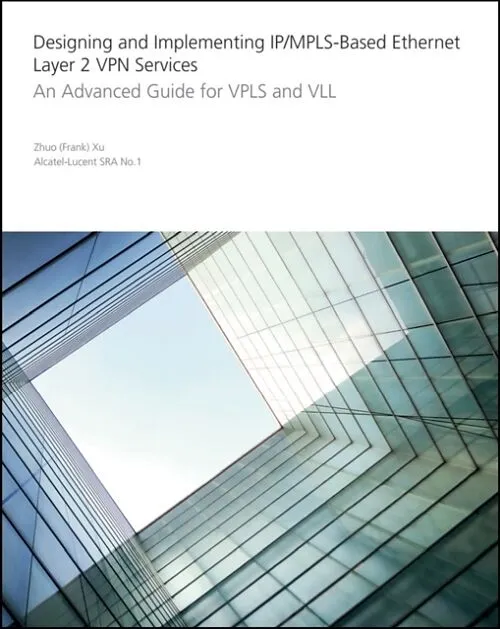
Designing and Implementing Ip/Mpls-Based Ethernet Layer 2 VPN Services
Beschreibung
Informationen zum Autor Zhuo (Frank) Xu is a recognized MPLS/VPLS service routing expert. A seasoned telecom professional, he holds several industry IP certifications including the distinction of being the world's first Alcatel-Lucent Service Routing Architect...Format auswählen
- Kartonierter EinbandCHF 108.00
Wird oft zusammen gekauft
Andere Kunden kauften auch
Beschreibung
Informationen zum Autor Zhuo (Frank) Xu is a recognized MPLS/VPLS service routing expert. A seasoned telecom professional, he holds several industry IP certifications including the distinction of being the world's first Alcatel-Lucent Service Routing Architect. Klappentext A guide to designing and implementing VPLS services over an IP/MPLS switched service provider backboneToday's communication providers are looking for convenience, simplicity, and flexible bandwidth across wide area networks-but with the quality of service and control that is critical for business networking applications like video, voice and data. Carrier Ethernet VPN services based on VPLS makes this a reality. Virtual Private LAN Service (VPLS) is a pseudowire (PW) based, multipoint-to-multipoint layer 2 Ethernet VPN service provided by services providers By deploying a VPLS service to customers, the operator can focus on providing high throughput, highly available Ethernet bridging services and leave the layer 3 routing decision up to the customer.Virtual Private LAN Services (VPLS) is quickly becoming the number one choice for many enterprises and service providers to deploy data communication networks. Alcatel-Lucent VPLS solution enables service providers to offer enterprise customers the operational cost benefits of Ethernet with the predictable QoS characteristics of MPLS.Items Covered:Building Converged Service Networks with IP/MPLS VPN TechnologyIP/MPLS VPN Multi-Service Network OverviewUsing MPLS Label Switched Paths as Service Transport TunnelsRouting Protocol Traffi c Engineering and CSPFRSVP-TE ProtocolMPLS Resiliency -- Secondary LSPMPLS Resiliency -- RSVP-TE LSP Fast RerouteLabel Distribution ProtocolIP/MPLS VPN Service Routing ArchitectureVirtual Leased Line ServicesVirtual Private LAN ServiceHierarchical VPLSHigh Availability in an IP/MPLS VPN NetworkVLL Service ResiliencyVPLS Service ResiliencyVPLS BGP Auto-DiscoveryPBB-VPLSOAM in a VPLS Service Network Zusammenfassung A guide to designing and implementing VPLS services over an IP/MPLS switched service provider backbone Today's communication providers are looking for convenience, simplicity, and flexible bandwidth across wide area networks-but with the quality of service and control that is critical for business networking applications like video, voice and data. Inhaltsverzeichnis Foreword xix Introduction xxi Part 1 IP/MPLS VPN Service Network Overview 1 Chapter 1 Building Converged Service Networks with IP/MPLS VPN Technology 3 1.1 The Increasing Demands on Service Provider Networks 4 1.2 MPLS Overview 6 1.3 The MPLS Value Proposition 8 1.4 MPLS Enables Converged Multi-Service Networks 11 1.5 MPLS-Enabled Business VPN Services 13 Summary 17 Chapter 2 IP/MPLS VPN Multi-Service Network Overview 19 2.1 IP/MPLS Layer 2 VPN Requirements 20 2.2 IP/MPLS Layer 2 VPN Services 21 2.3 Meeting the Service Network Requirements Using IP/MPLS VPN Architecture 26 2.4 IP/MPLS VPN-Enabled Applications 30 Summary 34 Part II IP/MPLS VPN Protocol Fundamentals 37 Chapter 3 Using MPLS Label Switched Paths as Service Transport Tunnels 39 3.1 Basic MPLS Concepts Review 40 3.2 Label Switch Path Types 51 3.3 LDP-LSP - LDP Label Distribution 54 3.4 RSVP-TE LSPs 64 3.5 Configuring RSVP-TE LSP 81 Summary 90 Chapter 4 Routing Protocol Traffi c Engineering and CSPF 91 4.1 Introducing Traffi c Engineering 92 4.2 Introducing OSPF-TE 97 4.3 Introducing IS-IS TE 112 4.4 The CSPF Algorithm 119 4.5 RSVP-TE LSP Policy Control: Administrative Groups and SRLG Groups 125 Summary 135 Chapter 5 RSVP-TE Protocol 137 5.1 RSVP and RSVP-TE 138 5.2 RSVP-TE Signaling Pro...
Autorentext
Zhuo (Frank) Xu is a recognized MPLS/VPLS service routing expert. A seasoned telecom professional, he holds several industry IP certifications including the distinction of being the world's first Alcatel-Lucent Service Routing Architect.
Klappentext
A guide to designing and implementing VPLS services over an IP/MPLS switched service provider backbone Today's communication providers are looking for convenience, simplicity, and flexible bandwidth across wide area networks-but with the quality of service and control that is critical for business networking applications like video, voice and data. Carrier Ethernet VPN services based on VPLS makes this a reality. Virtual Private LAN Service (VPLS) is a pseudowire (PW) based, multipoint-to-multipoint layer 2 Ethernet VPN service provided by services providers By deploying a VPLS service to customers, the operator can focus on providing high throughput, highly available Ethernet bridging services and leave the layer 3 routing decision up to the customer. Virtual Private LAN Services (VPLS) is quickly becoming the number one choice for many enterprises and service providers to deploy data communication networks. Alcatel-Lucent VPLS solution enables service providers to offer enterprise customers the operational cost benefits of Ethernet with the predictable QoS characteristics of MPLS. Items Covered: Building Converged Service Networks with IP/MPLS VPN Technology IP/MPLS VPN Multi-Service Network Overview Using MPLS Label Switched Paths as Service Transport Tunnels Routing Protocol Traffi c Engineering and CSPF RSVP-TE Protocol MPLS Resiliency -- Secondary LSP MPLS Resiliency -- RSVP-TE LSP Fast Reroute Label Distribution Protocol IP/MPLS VPN Service Routing Architecture Virtual Leased Line Services Virtual Private LAN Service Hierarchical VPLS High Availability in an IP/MPLS VPN Network VLL Service Resiliency VPLS Service Resiliency VPLS BGP Auto-Discovery PBB-VPLS OAM in a VPLS Service Network
Inhalt
Foreword xix
Introduction xxi
Part 1 IP/MPLS VPN Service Network Overview 1
Chapter 1 Building Converged Service Networks with IP/MPLS VPN Technology 3
1.1 The Increasing Demands on Service Provider Networks 4
1.2 MPLS Overview 6
1.3 The MPLS Value Proposition 8
1.4 MPLS Enables Converged Multi-Service Networks 11
1.5 MPLS-Enabled Business VPN Services 13
Summary 17
Chapter 2 IP/MPLS VPN Multi-Service Network Overview 19
2.1 IP/MPLS Layer 2 VPN Requirements 20
2.2 IP/MPLS Layer 2 VPN Services 21
2.3 Meeting the Service Network Requirements Using IP/MPLS VPN Architecture 26
2.4 IP/MPLS VPN-Enabled Applications 30
Summary 34
Part II IP/MPLS VPN Protocol Fundamentals 37
Chapter 3 Using MPLS Label Switched Paths as Service Transport Tunnels 39
3.1 Basic MPLS Concepts Review 40
3.2 Label Switch Path Types 51
3.3 LDP-LSP - LDP Label Distribution 54
3.4 RSVP-TE LSPs 64
3.5 Configuring RSVP-TE LSP 81
Summary 90
Chapter 4 Routing Protocol Traffi c Engineering and CSPF 91
4.1 Introducing Traffi c Engineering 92
4.2 Introducing OSPF-TE 97
4.3 Introducing IS-IS TE 112
4.4 The CSPF Algorithm 119
4.5 RSVP-TE LSP Policy Control: Administrative Groups and SRLG Groups 125
Summary 135
Chapter 5 RSVP-TE Protocol 137
5.1 RSVP and RSVP-TE 138
5.2 RSVP-TE Signaling Procedure 141
5.3 RSVP-TE Messages and Objects 150
5.4 Make-Before-Break (MBB) 176
5.5 The RSVP-TE Hello Protocol 191
5.6 Reducing RSVP Refresh Overhead 196
5.7 RSVP MD5 Authentication 206
Summary 207
Chapter 6 MPLS Resiliency - Secondary LSP 209
6.1 Ensuring Reliability with MPLS Resiliency 210
6.2 An Overview of Primary and Secondary LSPs 211
6.3 What Affects Convergence Performance? 217
6.4 Rules for Selecting Secondary LSPs 222
6.5 Case Study: Using Administrative Groups in Secondary LSPs 226
Summary 228
Chapter 7 MPLS Resiliency - RSVP-TE LSP Fast Reroute 231
7.1 RSVP-TE LSP Resiliency 232
7.2 Fast Reroute Overview 235
7.3 Fast Reroute Architecture 244
7.4 One-to-One Backup 259
7.5 Facility Backup 267
7.6 Manual Bypass Tunnel 283
Summary 288
Chapter 8 Label Distribution Protocol 291
8.1 LDP Overview 292
8.2 LDP Session Establishment and Management 292
8.3 Using T-LDP to Signal Pseudowires for L…