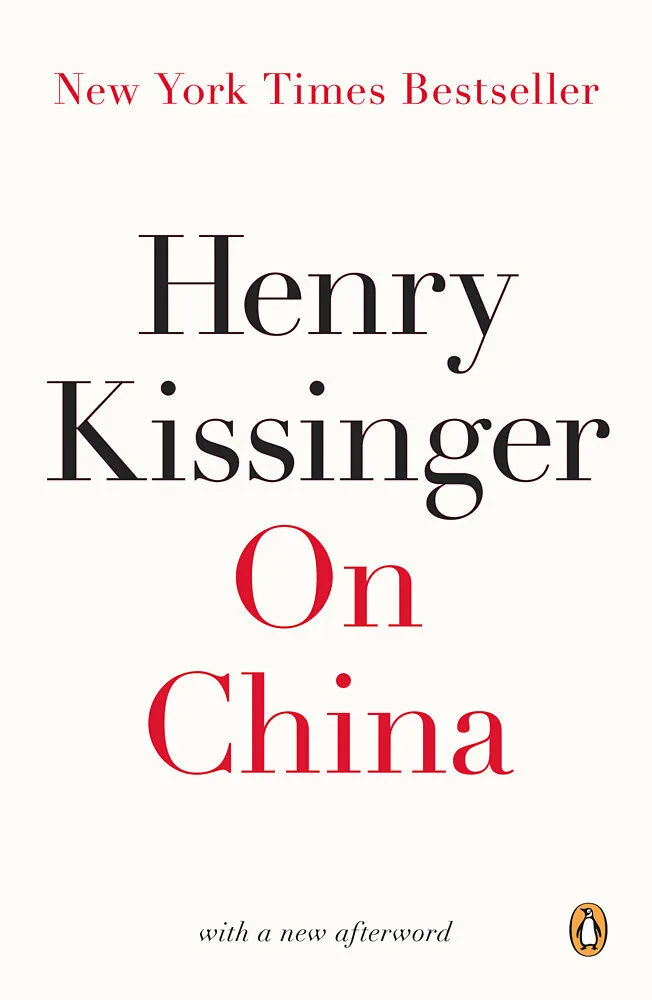
On China
Beschreibung
Kissinger, Nationaler Sicherheitsberater von 1969 bis 1973 und US-Außenminister von 1973 bis 1977, präsentiert ein umfassendes Bild von China, beginnend mit der Klassischen Ära bis hin zum heutigen Tag. Der Schwerpunkt liegt auf den Dekaden seit der Machtergre...Format auswählen
- Kartonierter EinbandCHF 30.70

Wird oft zusammen gekauft
Andere Kunden kauften auch
Beschreibung
Kissinger, Nationaler Sicherheitsberater von 1969 bis 1973 und US-Außenminister von 1973 bis 1977, präsentiert ein umfassendes Bild von China, beginnend mit der Klassischen Ära bis hin zum heutigen Tag. Der Schwerpunkt liegt auf den Dekaden seit der Machtergreifung Mao Tse-tungs, in welcher Zeit Kissinger selbst persönliche Erfahrungen mit vier chinesischen Staatsoberhäuptern machte. Besonders interessant sind Kissingers Gedanken zur Entwicklung der globalen Machtbalance im 21. Jahrhundert.
Informationen zum Autor Henry Kissinger Klappentext "Fascinating, shrewd . . . The book deftly traces the rhythms and patterns of Chinese history."-Michiko Kakutani, The New York Times In this sweeping and insightful history, Henry Kissinger turns for the first time at book length to a country he has known intimately for decades and whose modern relations with the West he helped shape. On China illuminates the inner workings of Chinese diplomacy during such pivotal events as the initial encounters between China and tight line modern European powers, the formation and breakdown of the Sino-Soviet alliance, the Korean War, and Richard Nixon's historic trip to Beijing. With a new final chapter on the emerging superpower's twenty-first-century role in global politics and economics, On China provides historical perspective on Chinese foreign affairs from one of the premier statesmen of our time. Leseprobe Chapter 1 The Singularity of China SOCIETIES AND NATIONS tend to think of themselves as eternal. They also cherish a tale of their origin. A special feature of Chinese civilization is that it seems to have no beginning. It appears in history less as a conventional nation-state than a permanent natural phenomenon. In the tale of the Yellow Emperor, revered by many Chinese as the legendary founding ruler, China seems already to exist. When the Yellow Emperor appears in myth, Chinese civilization has fallen into chaos. Competing princes harass each other and the people, yet an enfeebled ruler fails to maintain order. Levying an army, the new hero pacifies the realm and is acclaimed as emperor.1 The Yellow Emperor has gone down in history as a founding hero; yet in the founding myth, he is reestablishing, not creating, an empire. China predated him; it strides into the historical consciousness as an established state requiring only restoration, not creation. This paradox of Chinese history recurs with the ancient sage Confucius: again, he is seen as the founder of a culture although he stressed that he had invented nothing, that he was merely trying to reinvigorate the principles of harmony which had once existed in the golden age but had been lost in Confucius's own era of political chaos. Reflecting on the paradox of China's origins, the nineteenth-century missionary and traveler, the Abbé Régis-Evariste Huc, observed: Chinese civilization originates in an antiquity so remote that we vainly endeavor to discover its commencement. There are no traces of the state of infancy among this people. This is a very peculiar fact respecting China. We are accustomed in the history of nations to find some well-defined point of departure, and the historic documents, traditions, and monuments that remain to us generally permit us to follow, almost step by step, the progress of civilization, to be present at its birth, to watch its development, its onward march, and in many cases, its subsequent decay and fall. But it is not thus with the Chinese. They seem to have been always living in the same stage of advancement as in the present day; and the data of antiquity are such as to confirm that opinion. When Chinese written characters first evolved, during the Shang Dynasty in the second millennium B.C., ancient Egypt was at the height of its glory. The great city-states of classical Greece had not yet emerged, and Rome was millennia away. Yet the direct descendant of the Shang writing system is still used by well over a billion people today. Chinese today can understand inscriptions written in the age of Confucius; contemporary Chinese books and conversations are enriched by centuries-old aphorisms citing ancient battles and court intrigues. At the same time, Chinese history featured many periods of civil war, interregnum, and chaos. After each collapse, the Chinese state reconstituted itself as if by some immutable law of nature. At each stage, ...
Autorentext
Henry Kissinger
Klappentext
"Fascinating, shrewd . . . The book deftly traces the rhythms and patterns of Chinese history."-Michiko Kakutani, The New York Times
In this sweeping and insightful history, Henry Kissinger turns for the first time at book length to a country he has known intimately for decades and whose modern relations with the West he helped shape. On China illuminates the inner workings of Chinese diplomacy during such pivotal events as the initial encounters between China and tight line modern European powers, the formation and breakdown of the Sino-Soviet alliance, the Korean War, and Richard Nixon's historic trip to Beijing. With a new final chapter on the emerging superpower's twenty-first-century role in global politics and economics, On China provides historical perspective on Chinese foreign affairs from one of the premier statesmen of our time.
Leseprobe
Chapter 1
The Singularity of China
SOCIETIES AND NATIONS tend to think of themselves as eternal. They also cherish a tale of their origin. A special feature of Chinese civilization is that it seems to have no beginning. It appears in history less as a conventional nation-state than a permanent natural phenomenon. In the tale of the Yellow Emperor, revered by many Chinese as the legendary founding ruler, China seems already to exist. When the Yellow Emperor appears in myth, Chinese civilization has fallen into chaos. Competing princes harass each other and the people, yet an enfeebled ruler fails to maintain order. Levying an army, the new hero pacifies the realm and is acclaimed as emperor.1
The Yellow Emperor has gone down in history as a founding hero; yet in the founding myth, he is reestablishing, not creating, an empire. China predated him; it strides into the historical consciousness as an established state requiring only restoration, not creation. This paradox of Chinese history recurs with the ancient sage Confucius: again, he is seen as the “founder” of a culture although he stressed that he had invented nothing, that he was merely trying to reinvigorate the principles of harmony which had once existed in the golden age but had been lost in Confucius’s own era of political chaos.
Reflecting on the paradox of China’s origins, the nineteenth-century missionary and traveler, the Abbé Régis-Evariste Huc, observed:
Chinese civilization originates in an antiquity so remote that we vainly endeavor to discover its commencement. There are no traces of the state of infancy among this people. This is a very peculiar fact respecting China. We are accustomed in the history of nations to find some well-defined point of departure, and the historic documents, traditions, and monuments that remain to us generally permit us to follow, almost step by step, the progress of civilization, to be present at its birth, to watch its development, its onward march, and in many cases, its subsequent decay and fall. But it is not thus with the Chinese. They seem to have been always living in the same stage of advancement as in the present day; and the data of antiquity are such as to confirm that opinion.
When Chinese written characters first evolved, during the Shang Dynasty in the second millennium B.C., ancient Egypt was at the height of its glory. The great city-states of classical Greece had not yet emerged, and Rome was millennia away. Yet the direct descendant of the Shang writing system is still used by well over a billion people today. Chinese to…