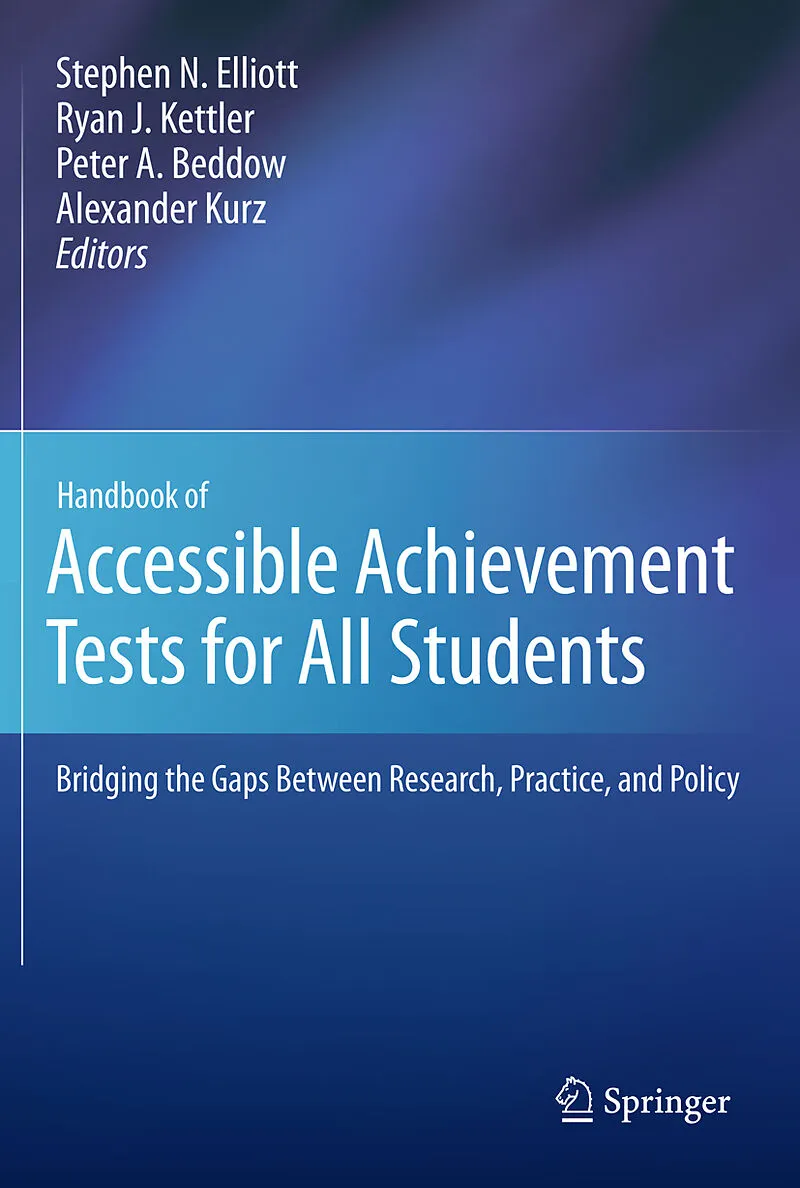
Handbook of Accessible Achievement Tests for All Students
Beschreibung
Drawing on an extensive theoretical and research base, and covering both policy concerns and test design issues, this handbook shows how to move student assessment beyond 'universal' standards and towards practices that genuinely enhance learning out...Format auswählen
- Kartonierter EinbandCHF 73.60
- Fester EinbandCHF 139.60
- Kartonierter EinbandCHF 229.60
- Fester EinbandCHF 229.60
- E-Book (pdf)CHF 260.90

Wird oft zusammen gekauft
Andere Kunden kauften auch
Beschreibung
Drawing on an extensive theoretical and research base, and covering both policy concerns and test design issues, this handbook shows how to move student assessment beyond 'universal' standards and towards practices that genuinely enhance learning outcomes.
The Handbook of Accessible Achievement Tests for All Students: Bridging the Gaps Between Research, Practice, and Policy presents a wealth of evidence-based solutions designed to move the assessment field beyond universal standards and policies toward practices that enhance learning and testing outcomes. Drawing on an extensive research and theoretical base as well as emerging areas of interest, the volume focuses on major policy concerns, instructional considerations, and test design issues, including:
- The IEP team's role in sound assessment.
- The relationships among opportunity to learn, assessment, and learning outcomes.
- Innovations in computerized testing and the 6D framework for standard setting.
- Legal issues in the assessment of special populations.
- Guidelines for linguistically accessible assessments.
- Evidence-based methods for making item modifications that increase the validity of inferences from test scores.
- Strategies for writing clearer test items.
- Methods for including student input in assessment design.
- Suggestions for better measurement and tests that are more inclusive.
This Handbook is an essential reference for researchers, practitioners, and graduate students in education and allied disciplines, including child and school psychology, social work, special education, learning and measurement, and education policy.
Provides comprehensive coverage of the concept of accessibility and its application to the design and use of tests with all students Covers in depth the topics of test accessibility and test design Addresses the subject within the context of NCLB, including the modified alternate assessment amendments of April 2007, and item modification research Details the most current research in testing accommodations, large-scale assessment, and educational accountability Includes supplementary material: sn.pub/extras
Autorentext
Stephen N. Elliott, PhD is the founding Director of the Learning Sciences Institute, a trans-university research enterprise at Arizona State University, and is the Mickelson Foundation Professor of Education. He received his doctorate at Arizona State University in 1980 and has been on the faculty at several major research universities, including the University of Wisconsin-Madison and Vanderbilt University. At Wisconsin (1987-2004), Steve was a professor of educational psychology and served as the Associate Director of the Wisconsin Center for Education Research. At Vanderbilt (2004-2010), he was the Dunn Family Professor of Educational and Psychological Assessment in the Special Education Department and directed the Learning Sciences Institute and Dunn Family Scholars Program. His research focuses on scale development and educational assessment practices. In particular, he has published articles on (a) the assessment of children's social skills and academic competence, (b) the use of testing accommodations and alternate assessment methods for evaluating the academic performance of students with disabilities for educational accountability, and (c) students' opportunities to learn the intended curriculum. Steve's scholarly and professional contributions have been recognized by his colleagues in education and psychology research as evidenced by being selected as an American Psychological Association Senior Scientist in 2009. Steve consults with state assessment leaders on the assessment and instruction of PreK-12 students, and serves on ETS's Visiting Research Panel, and is the Director of Research and Scientific Practice for the Society of the Study of School Psychology.
Ryan J. Kettler, PhD is a Research Assistant Professor in Special Education at Peabody College of Vanderbilt University. He received his doctorate in Educational Psychology, with a specialization in School Psychology, from the University of Wisconsin-Madison in2005. Ryan's dissertation, Identifying students who need help early: Validation of the Brief Academic Competence Evaluation Screening System , won the 2006 Outstanding Dissertation award from the Wisconsin School Psychologists Association. In 2007, he was named an Early Career Scholar by the Society for the Study of School Psychology. Prior to joining Vanderbilt University, Ryan was an assistant professor at California State University, Los Angeles, and completed an APA-accredited internship at Ethan Allen School in Wales, Wisconsin. He has worked on multiple federally funded grants examining the effectiveness of alternate assessments, academic and behavioral screening systems, and testing accommodations. Ryan is the author of peer reviewed publications and presentations within the broader area of data-based assessment for intervention, representing specific interests in academic and behavioral screening, inclusive assessment, reliability and validity issues, and rating scale technology. He currently serves as a consultant to College Board and to the Wisconsin Center for Education Research, providing expertise in the area of inclusive assessment.
Peter A. Beddow, PhD received his doctorate in Special Education and Educational Psychology at Vanderbilt University in 2011. His research focuses on test accessibility and item-writing for assessments of student achievement. He is the senior author of the Test Accessibility and Modification Inventory (TAMI) and the Accessibility Rating Matrix , a set of tools for evaluating the accessibility of test items for learners with a broad range of abilities and needs. Based on his work on accessibility theory, Peter was awarded the Bonsal Education Research Entrepreneurship Award in 2009 and the Melvyn R. Semmel Dissertation Research Award in 2010. Prior to beginning his academic career, Peter taught for seven years in Los Angeles County, including five years teaching Special Education forstudents with emotional and behavior problems at Five Acres School, part of a residential treatment facility for children who are wards-of-the-court for reasons of abuse and neglect. Peter's primary goal is to help children realize their infinite value and achieve their ultimate potential. Pete lives in Nashville, Tennessee.
Alexander Kurz, MEd is a doctoral student in Special Education and the Interdisciplinary Program in Educational Psychology at Vanderbilt University. He has studied in Germany and the U.S. earning degrees in Special Education and Philosophy. Upon moving to the U.S., he worked as a special education teacher in Tennessee and California, designed and implemented curricula for reading intervention classes, and participated in school reform activities through the Bill and Melinda Gates Foundation. Prior to beginning his doctoral studies, Alex worked as behavior analyst for children with autism and as an educational consultant to Discovery Education Assessment. During his graduate work at Vanderbilt, he collaborated with the Wisconsin Center for Education Research and Discovery Education Assessment leading research efforts to examine curricular alignment and its relation to student achievement for students with and without disabilities. Alex has coauthored several peer-reviewed publications on alignment and alternate assessment. His latest scholarly contributions have reexamined the concepts of opportunity-to-learn (OTL), alignment, and access to the general curriculum in the context of curricular frameworks for general and special education. Alex is the senior author of My Instructional Learning Opportunities Guidance System , a teacher-oriented OTL measurement tool. His current interest in educational technology and innovation is aimed at identifying and creating pragmatic s…