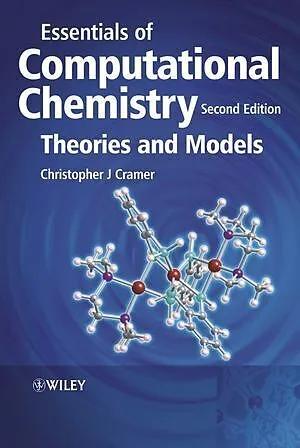
Essentials of Computational Chemistry
Beschreibung
Ohne Computational Chemistry kommen heutzutage weder Physikochemiker noch Synthetiker oder Analytiker aus. Entsprechend wichtig ist es, diesem Gebiet bereits während des Studiums gebührenden Raum zu widmen. Dieses Lehrbuch hilft vor allem bei der Vermittlung g...Format auswählen
- Kartonierter EinbandCHF 77.60
Wird oft zusammen gekauft
Andere Kunden kauften auch
Beschreibung
Ohne Computational Chemistry kommen heutzutage weder Physikochemiker noch Synthetiker oder Analytiker aus. Entsprechend wichtig ist es, diesem Gebiet bereits während des Studiums gebührenden Raum zu widmen. Dieses Lehrbuch hilft vor allem bei der Vermittlung grundlegender Konzepte anhand zahlreicher Beispiele aus der organischen, anorganischen und Biochemie, während die theoretischen und mathematischen Hintergründe weniger ausführlich behandelt werden.
Informationen zum Autor Christopher Cramer, Professor of Computational Chemistry Department of Chemistry, University of Minnesota,Minneapolis, USA Klappentext Essentials of Computational Chemistry, Theories and Models, Second Edition provides an accessible introduction to this fast developing subject. Extensively revised and updated, the Second Edition has been carefully developed to encourage student understanding and to establish seamlessconnections with the primary literature for the advanced reader. The book opens with a presentation of classical models, before gradually moving on to increasingly more complex quantum mechanical and dynamical theories. Coverage and examples are drawn from inorganic, organic and biological chemistry.* evolving topics like density functional theory, continuum solvation models, and computational thermochemistry brought firmly up-to-date* carefully guides the reader through key equations, providing background information and placing each in context.* numerous examples and applications with selected case studies designed as a basis for classroom discussion.* supplementary website with exercises problems and updates: www.pollux.chem.umn.edu/8021/Invaluable to all students taking a first course in computational chemistry, molecular modelling, computational quantum chemistry or electronic structure theory. This book will also be of interest to postgraduates, researchers and professionals needing an up-to-date, accessible introduction to this subject.Reviews of the First Edition"This is an excellent text for graduates or advanced undergraduates in any field of chemistry......the text provides an excellent introduction to the field for students and researchers in any area of chemistry" Theoretical Chemistry Accounts, 2003".....this book has a lot to recommend to undergraduate students as a way of getting them involved in computational chemistry...Professor Cramer has done a superb job and deserves congratulating" The Alchemist, 2003" 'Essentials' is a useful tool not only for teaching and learning but also as a quick reference, and thus will most probably become one of the standard text books for computational chemistry"Journal of Chemical Information and Computer Science, 2003 Zusammenfassung Dieses Lehrbuch hilft vor allem bei der Vermittlung grundlegender Konzepte anhand zahlreicher Beispiele aus der organischen, anorganischen und Biochemie, während die theoretischen und mathematischen Hintergründe weniger ausführlich behandelt werden. Inhaltsverzeichnis Preface to the First Edition.Preface to the Second Edition.Acknowledgments.1. What are Theory, Computation, and Modeling?2. Molecular Mechanics.3. Simulations of Molecular Ensembles.4. Foundations of Molecular Orbital Theory.5. Semiempirical Implementations of Molecular Orbital Theory..6. Ab Initio Implementations of Hartree-Fock Molecular Orbital.Theory.7. Including Electron Correlation in Molecular Orbital Theory.8. Density Functional Theory.9. Charge Distribution and Spectroscopic Properties.10. Thermodynamic Properties.11. Implicit Models for Condensed Phases.12. Explicit Models for Condensed Phases.13. Hybrid Quantal/Classical Models.14. Excited Electronic States.15. Adiabatic Reaction Dynamics.Appendix A Acronym Glossary.Appendix B Symmetry and Group Theory.Appendix C Spin Algebra.Appendix D Orbital Localization. ...
Autorentext
Christopher Cramer, Professor of Computational Chemistry Department of Chemistry, University of Minnesota,Minneapolis, USA
Klappentext
Dieses Lehrbuch hilft vor allem bei der Vermittlung grundlegender Konzepte anhand zahlreicher Beispiele aus der organischen, anorganischen und Biochemie, wahrend die theoretischen und mathematischen Hintergrunde weniger ausfuhrlich behandelt werden.
Inhalt
Preface to the First Edition xv
Preface to the Second Edition xix
Acknowledgments xxi
1 What are Theory, Computation, and Modeling? 1
1.1 Definition of Terms 1
1.2 Quantum Mechanics 4
1.3 Computable Quantities 5
1.4 Cost and Efficiency 11
1.5 Note on Units 15
2 Molecular Mechanics 17
2.1 History and Fundamental Assumptions 17
2.2 Potential Energy Functional Forms 19
2.3 Force-field Energies and Thermodynamics 39
2.4 Geometry Optimization 40
2.5 Menagerie of Modern Force Fields 50
2.6 Force Fields and Docking 62
2.7 Case Study: (2R ,4S )-1-Hydroxy-2,4-dimethylhex-5-ene 64
3 Simulations of Molecular Ensembles 69
3.1 Relationship Between MM Optima and Real Systems 69
3.2 Phase Space and Trajectories 70
3.3 Molecular Dynamics 72
3.4 Monte Carlo 80
3.5 Ensemble and Dynamical Property Examples 82
3.6 Key Details in Formalism 88
3.7 Force Field Performance in Simulations 98
3.8 Case Study: Silica Sodalite 99
4 Foundations of Molecular Orbital Theory 105
4.1 Quantum Mechanics and the Wave Function 105
4.2 The Hamiltonian Operator 106
4.3 Construction of Trial Wave Functions 111
4.4 H uckel Theory 115
4.5 Many-electron Wave Functions 119
5 Semiempirical Implementations of Molecular Orbital Theory 131
5.1 Semiempirical Philosophy 131
5.2 Extended H uckel Theory 134
5.3 CNDO Formalism 136
5.4 INDO Formalism 139
5.5 Basic NDDO Formalism 143
5.6 General Performance Overview of Basic NDDO Models 147
5.7 Ongoing Developments in Semiempirical MO Theory 152
5.8 Case Study: Asymmetric Alkylation of Benzaldehyde 159
6 Ab Initio Implementations of Hartree-Fock Molecular Orbital Theory 165
6.1 Ab Initio Philosophy 165
6.2 Basis Sets 166
6.3 Key Technical and Practical Points of Hartree-Fock Theory 180
6.4 General Performance Overview of Ab Initio HF Theory 192
6.5 Case Study: Polymerization of 4-Substituted Aromatic Enynes 199
7 Including Electron Correlation in Molecular Orbital Theory 203
7.1 Dynamical vs. Non-dynamical Electron Correlation 203
7.2 Multiconfiguration Self-Consistent Field Theory 205
7.3 Configuration Interaction 211
7.4 Perturbation Theory 216
7.5 Coupled-cluster Theory 224
7.6 Practical Issues in Application 227
7.7 Parameterized Methods 237
7.8 Case Study: Ethylenedione Radical Anion 244
8 Density Functional Theory 249
8.1 Theoretical Motivation 249
8.2 Rigorous Foundation 252
8.2.1 The Hohenberg-Kohn Existence Theorem 252
8.3 Kohn-Sham Self-consistent Field Methodology 255
8.4 Exchange-correlation Functionals 257
8.5 Advantages and Disadvantages of DFT Compared to MO Theory 271
8.6 General Performance Overview of DFT 280
8.7 Case Study: Transition-Metal Catalyzed Carbonylation of Methanol 299
9 Charge Distribution and Spectroscopic Properties 305
9.1 Properties Related to Charge Distribution 305
9.2 Ionization Potentials and Electron Affinities 330
9.3 Spectroscopy of Nuclear Motion 331
9.4 NMR Spectral Properties 344
9.5 Case Study: Matrix Isolation of Perfluorinated p-Benzyne 349
10 Thermodynamic Properties 355
10.1 Microscopic-macroscopic Connection 355
10.2 Zero-point Vibrational Energy 356
10.3 Ensemble Properties and Basic Statistical Mechanics 357
10.4 Standard-state Heats and Free Energies of Formation and Reaction 366
10.5 Technical Caveats 375
10.6 Case Study: Heat of Formation of H2NOH 381
11 Implicit Models for Condensed Phases 385
11.1 Condensed-phase Effects on Structure and Reactivity 385
11.2 Electrostatic Interactions with a Continuum 393
11.3 Continuum Models for Non-electrostatic Interactions 406
11.4 Strengths and Wea…